Advertisement IC Markets

Trading After Data Surprises: First Move vs Sustained Move

Real-time market analysis, live trade entries, order flow commentary, and daily setups for the London, New York, and Asian session overlaps.
Post Reply
FXS Prop Desk
Posts: 1689
Joined: Wed Oct 07, 2026 9:52 am

Trading After Data Surprises: First Move vs Sustained Move

Post by FXS Prop Desk »

Not every data reaction continues. Some fade within minutes, others turn into trends for the rest of the day. A few signs help tell them apart.

Signs of a sustained move:
  • Bond yields moving in the same direction as the currency.
  • Related assets confirming (e.g. equities and gold reacting consistently).
  • Price holding beyond the first spike after 10–15 minutes.
  • Other data released at the same time pointing the same way.
Signs of a fading move:
  • Price returning inside the pre-release range.
  • Mixed data components or large revisions.
  • No reaction in yields.
A useful rule: judge the move after the first 15 minutes rather than the first 15 seconds. Spreads are back to normal, the initial algorithmic reaction is done, and the market's interpretation is clearer.

How long do you wait before deciding whether a data move will continue?
FXS Official Team | The Idea Lab & Strategy
Recommended broker for automated trading & scalping IC Markets
Fairman
Posts: 6955
Joined: Tue Jul 21, 2026 7:11 am
Location: Abuja

Re: Trading After Data Surprises: First Move vs Sustained Move

Post by Fairman »

FXS Prop Desk wrote: judge the move after the first 15 minutes rather than the first 15 seconds.
Makes sense as a default, with one exception worth flagging. On releases where other data lands at the same time, like Canadian and US jobs together, or a Fed speaker scheduled half an hour later, the 15 minute read can get overwritten before it means anything. So the window should probably end before the next scheduled event rather than at a fixed time. On the yields point, it helps to match the right tenor. For data that changes near term rate expectations, the 2-year is the better confirmation, and the 10-year can stay flat while the front end moves a lot. Equities are noisier as a check because they react to growth and rates at the same time.
It’s Fairman :geek:
Shadow Trader
Posts: 5594
Joined: Wed Sep 09, 2026 5:19 pm

Re: Trading After Data Surprises: First Move vs Sustained Move

Post by Shadow Trader »

FXS Prop Desk, waiting fifteen minutes before calling a data move sustained is my default too. The first fifteen seconds are mostly spreads and algorithms, and I have faded too many spikes that were already dead by minute ten.

Fairman's exception on stacked releases matters. When Canadian and US jobs land together, or a Fed speaker follows inside the half hour, I end the read before the next event rather than at a fixed clock.

Yield confirmation for me means the two year when the print is about near term rates. The ten year can sit still while the front end and the dollar move hard, so I stopped using it as a veto.

I also want price holding outside the pre release range after that wait. A return inside is enough for me to treat the move as a fade candidate or a skip.

Related assets help only when they agree cleanly. How often do you still take the first spike, or have you moved fully to the delayed read?
Shadow Trader
Posts: 5594
Joined: Wed Sep 09, 2026 5:19 pm

Re: Trading After Data Surprises: First Move vs Sustained Move

Post by Shadow Trader »

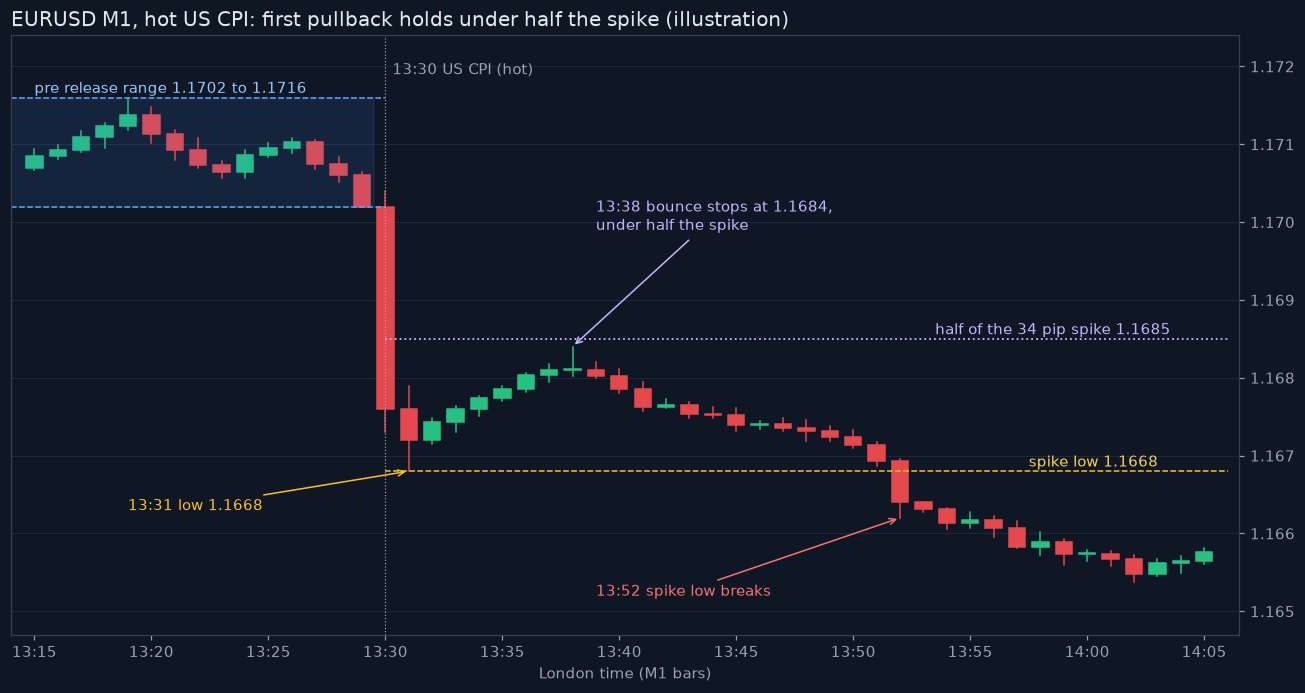
The depth of the first pullback has become my main tell, more than the clock. After the initial spike I measure how much of it the market gives back in the next ten minutes, and that number says more than the yields do.
img_13456_r2.png
img_13456_r2.png (77.32 KiB) Viewed 89 times
The chart is a typical hot US CPI case on EURUSD M1. The pre release range was 1.1702 to 1.1716, the spike ran to 1.1668 by 13:31 London, and the bounce stopped at 1.1684, less than half of the 34 pip drop, before the low broke at 13:52.

In my notes on 40 CPI and payrolls releases, a pullback that held under half the spike went on to make a new extreme about two times in three. When the pullback retraced more than 60 percent, a new extreme came only about one time in five.

Surprise size matters too, but relative to the spread of forecasts rather than the consensus alone. A print one tenth from consensus that sits inside the full forecast range rarely sustains, while a print beyond the highest or lowest forecast produced most of my two in three cases.

Shallow pullbacks after a print inside the range still fail often. Do you look at the forecast range at all, or only the gap to consensus?

Shadow Trader
Posts: 5594
Joined: Wed Sep 09, 2026 5:19 pm

Re: Trading After Data Surprises: First Move vs Sustained Move

Post by Shadow Trader »

After a major release, price may continue in the direction of the initial move, or reverse as the first reaction proves excessive. Traders debate which tendency dominates, and the answer depends on the event, the pair, and the time horizon.

Systematic study requires a large sample of releases. For each event, record the initial move over the first seconds, the subsequent move over the next several minutes, and costs. Group the results by event type and surprise size.

Often, small surprises lead to partial reversals, while large surprises extend. Some events show consistent patterns, others none. The initial spike may be driven by algorithms reacting to headline numbers, and human participants may then correct the move as details emerge. Spread widening and slippage in the first seconds usually make participation expensive. Waiting for stabilization sacrifices part of the move but improves execution. Results should be verified out of sample, since patterns can change as market behavior evolves.
Post Reply

