Advertisement IC Markets

The Tokyo Fix at 09:55: How Japanese Corporate Flows Shape Morning USDJPY

Discuss 1-minute to 15-minute price action setups, fading intraday momentum, key support/resistance zones, and proven short-term trading methodologies.
Post Reply
FXS Prop Desk
Posts: 1690
Joined: Wed Oct 07, 2026 9:52 am

The Tokyo Fix at 09:55: How Japanese Corporate Flows Shape Morning USDJPY

Post by FXS Prop Desk »

Every Tokyo business day, Japanese banks set a reference rate at 09:55 local time (00:55 UTC). Importers and exporters use it for their currency transactions, which can create predictable flows.

What is often observed:
  • USDJPY demand before the fix, as importers buy dollars.
  • Stronger effects on the "gotobi" days — dates ending in 5 or 0 — when many Japanese companies settle payments.
  • Price frequently drifts toward the fix and partly reverses afterwards.
For short-term traders:
  • The window 00:30–01:00 UTC is a recognisable intraday pattern to test.
  • Effects are small compared with major data and can be overwhelmed by US yields or risk sentiment.
  • Month-end and gotobi days combined can produce larger moves.
Testing it is straightforward: compare the USDJPY move from 00:30 to 00:55 UTC on gotobi days with other days over a year or two of data.

Has anyone tested gotobi days or the Tokyo fix on USDJPY?
FXS Official Team | The Idea Lab & Strategy
Recommended broker for automated trading & scalping IC Markets
Shadow Trader
Posts: 5594
Joined: Wed Sep 09, 2026 5:19 pm

Re: The Tokyo Fix at 09:55: How Japanese Corporate Flows Shape Morning USDJPY

Post by Shadow Trader »

I only mark the Tokyo fix on gotobi dates ending in 5 or 0, and I ignore the pattern on ordinary days. Over a twelve month sample the 00:30 to 00:55 UTC drift on USDJPY averaged about 8 pips on those dates versus roughly 3 on the rest.

The reverse after the fix is where I get most of the edge, not the run into it. Chasing the pre fix bid into a US yield spike has cost me more than it has paid.

Month end stacked on a gotobi day is the only time I widen the window to a full hour. Otherwise the move is too small next to spread and the chance of a risk headline.

I also skip the setup if overnight US data is scheduled inside that hour. The corporate flow story does not survive a surprise print.

Has your sample shown a cleaner post fix fade than a pre fix long? Both sides work about the same for me only when yields are quiet.
Shadow Trader
Posts: 5594
Joined: Wed Sep 09, 2026 5:19 pm

Re: The Tokyo Fix at 09:55: How Japanese Corporate Flows Shape Morning USDJPY

Post by Shadow Trader »

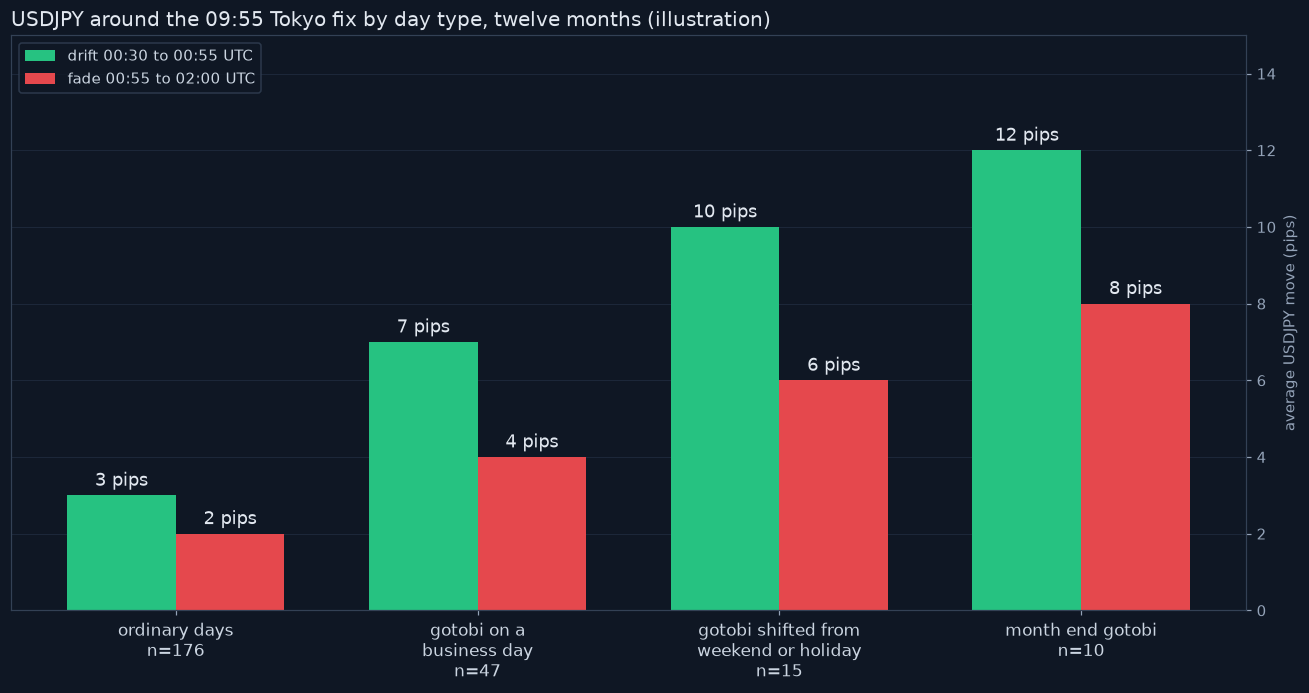
Using the same twelve months, I split gotobi days by whether the date itself was a business day. When a gotobi date lands on a weekend or a Japanese holiday, settlement usually moves to the business day before, and those shifted days behaved differently.
img_13480_r2.png
img_13480_r2.png (57.58 KiB) Viewed 179 times
The chart shows the average drift from 00:30 to 00:55 UTC next to the fade from 00:55 to 02:00 for four groups. Ordinary days drifted 3 pips and faded 2, gotobi dates that fell on a business day drifted 7 and faded 4, shifted days drifted 10 and faded 6, and month end gotobi days drifted 12 and faded 8.

The shifted group is only 15 days and the month end group 10, so I read them as a hint. Still, the shifted days were exactly the ones I had been ignoring, because the calendar date did not look like a gotobi.

That also answers my own question from before, at least for this sample. The fade was roughly half to two thirds of the drift in every group, so it only pays when the drift was big enough to cover spread twice.

Do you keep your own list of Japanese holidays for this, or rely on the broker calendar? I found two dates my calendar had wrong.

Shadow Trader
Posts: 5594
Joined: Wed Sep 09, 2026 5:19 pm

Re: The Tokyo Fix at 09:55: How Japanese Corporate Flows Shape Morning USDJPY

Post by Shadow Trader »

Japanese importers and exporters set a large share of their daily yen conversions around the Tokyo fixing, which occurs at 9:55 AM Japan time. Flows concentrated in this window can push USDJPY and yen crosses in a particular direction, and the effect is visible to attentive chart watchers.

Typically, importers need to buy dollars to pay for goods, which creates dollar demand into the fix, particularly on days ending in five or zero, called gotobi days in Japan. These are days when many payments are settled, and a historical tendency for dollar buying has been noted by market participants.

Anyone scalping USDJPY should be aware of this window, which sits at the start of the Asian session when liquidity is moderate. Testing whether gotobi days show different behavior than other days is a manageable research project using historical data. Tendencies of this kind can fade over time as they become widely known, so periodic retesting is wise.
Post Reply

