One thing the table hides is how you size. With a fixed risk of 500 dollars on a 100k account, a 10,000 dollar hole is 20R to win back, the same 20R it took to lose. The asymmetry only bites when risk is a percent of current equity, so each R shrinks as the balance falls.
On prop accounts the more useful number is room left, not drawdown taken. At minus 6 on a static 10 percent limit there is 4 percent of room, and I size so 16 straight losses fit inside it, which is 0.25 percent per trade.
- img_13716_r1.png (83.05 KiB) Viewed 7 times
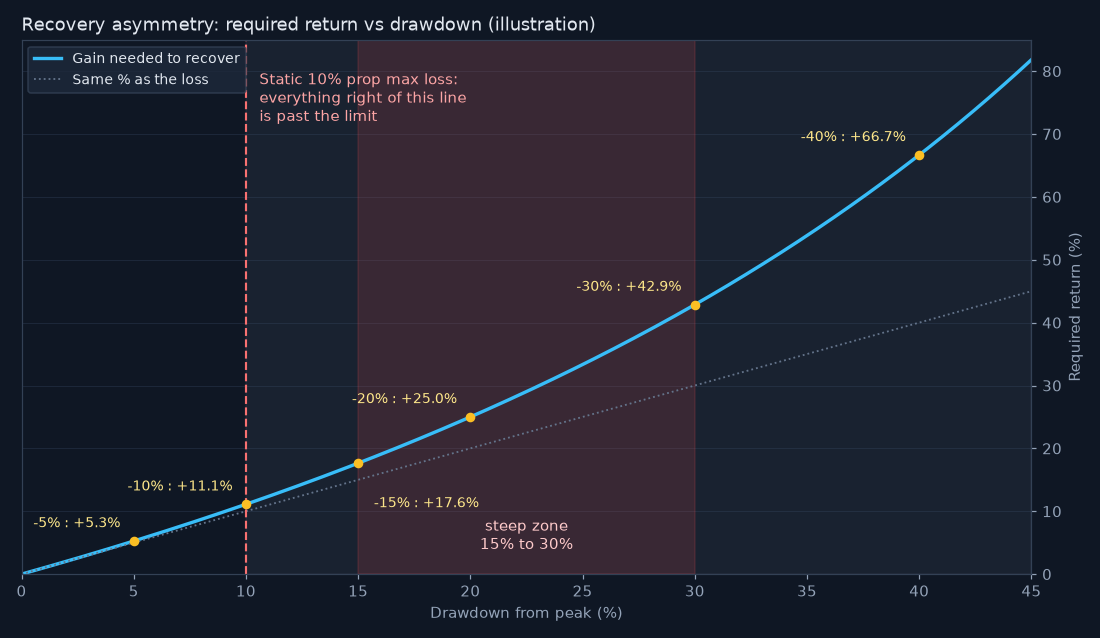
The illustration plots the post's table as a curve with the 10 percent limit marked, and the steep stretch between 15 and 30 percent sits entirely past the line a funded trader can reach. Retail accounts are the ones that wander into that part.
I agree with cutting size, but I cut on consecutive losses as well as depth. Four losers in a row halve my size even if the account is only down 2 percent.
What I have not solved is when to step back up. Half the drawdown recovered feels arbitrary, so I am testing ten trades at reduced size with positive expectancy before returning to normal.


