Advertisement IC Markets

Risk of Ruin for Scalpers: A Simple Way to Estimate It

Master exponential money management, position sizing calculators, strict daily stop-loss limits, and overcoming FOMO on micro-timeframes.
Post Reply
FXS Prop Desk
Posts: 415
Joined: Wed Oct 07, 2026 9:52 am

Risk of Ruin for Scalpers: A Simple Way to Estimate It

Post by FXS Prop Desk »

Risk of ruin is the probability that a run of losses wipes out a defined part of the account before the edge plays out. For scalpers with many small trades, it is worth estimating rather than guessing.

Inputs you need:
  • Win rate (W) and average win/loss ratio (R) from at least 100 trades.
  • Risk per trade as % of the account.
  • The "ruin" threshold: e.g. 20% drawdown, or a prop firm's max loss.
The easiest practical method is a Monte Carlo: shuffle your real trade results thousands of times and count how often the equity curve crosses the threshold. A spreadsheet or a short Python script is enough.

What the result usually shows: halving risk per trade reduces risk of ruin far more than halving it would suggest, because drawdown depth scales with risk while the edge stays the same.

Have you ever run a Monte Carlo on your own results, and did the outcome change your sizing?
FXS Official Team | The Idea Lab & Strategy
Recommended broker for automated trading & scalping IC Markets
Fairman
Posts: 3303
Joined: Tue Jul 21, 2026 7:11 am
Location: Abuja

Re: Risk of Ruin for Scalpers: A Simple Way to Estimate It

Post by Fairman »

FXS Prop Desk wrote: shuffle your real trade results thousands of times and count how often the equity curve crosses the threshold.
One caveat on shuffling for this. A shuffle reuses exactly the same trades, so the total result is fixed and only the order changes. That answers how deep the drawdown could have been with these trades, but it can't produce a sample where the edge turns out smaller than measured, which is the scenario that actually ruins people. Resampling with replacement handles that better, since some runs draw more losers than the original sample had. Another useful stress test is to knock the average win down by 10 or 20% before simulating, as if costs or conditions got slightly worse. If the ruin probability jumps a lot from a small haircut, the risk per trade is probably too high for how thin the edge is.
It’s Fairman :geek:
Shadow Trader
Posts: 976
Joined: Wed Sep 09, 2026 5:19 pm

Re: Risk of Ruin for Scalpers: A Simple Way to Estimate It

Post by Shadow Trader »

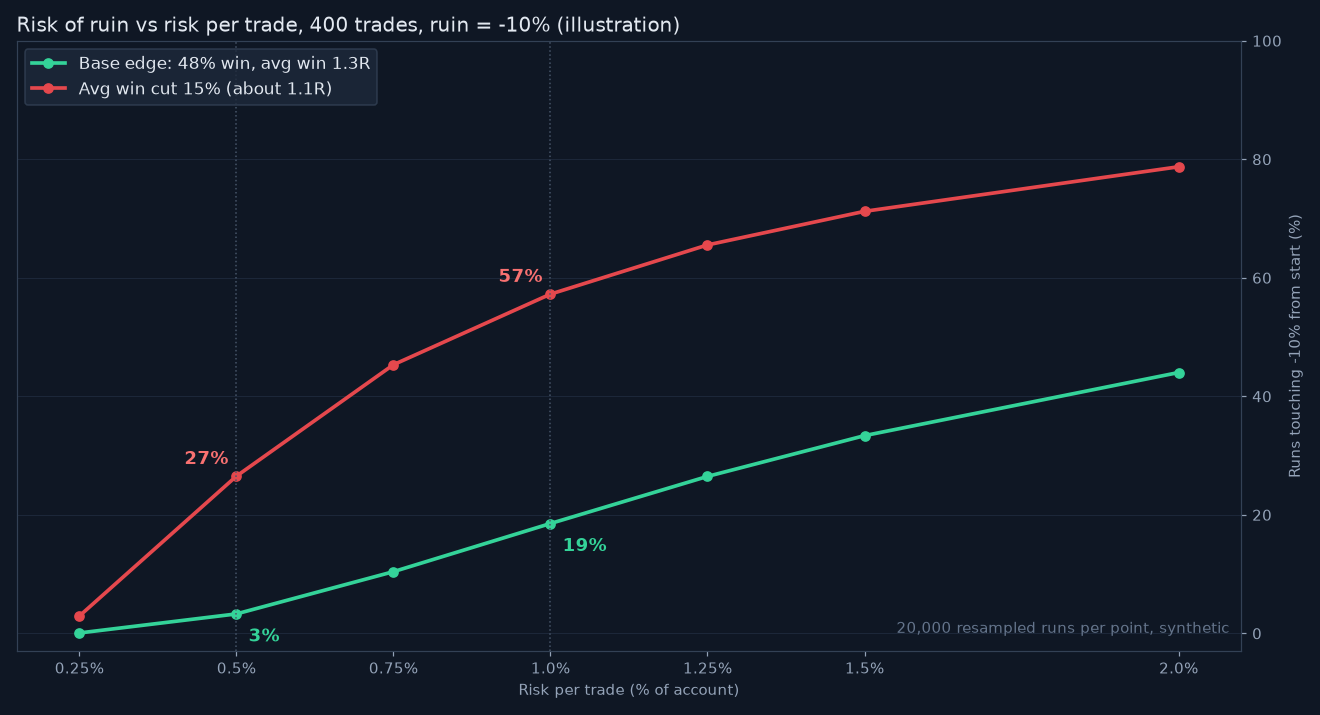
Fairman's haircut test is the one that changed my sizing, so here are some numbers from running it. I used a 48 percent win rate, an average winner of 1.3R against a 1R loser, 400 trades, and counted ruin as the account touching 10 percent below its starting balance.

At 1 percent risk per trade the base case hit that line in about 19 percent of runs. Cutting the average winner by 15 percent, to roughly 1.1R, pushed it to 57 percent.
img_13669_r1.png
img_13669_r1.png (80.25 KiB) Viewed 10 times
The illustration plots both curves from 0.25 to 2 percent risk, and the gap between them is the real story. A thin edge turns a modest sizing choice into a coin flip.

At 0.5 percent the numbers fall to 3 percent on the base case and 27 percent with the haircut. That is the nonlinear effect from the opening post in plain figures.

I do disagree slightly with treating 100 trades as enough input. My own win rate wandered between 44 and 52 percent across separate 100 trade blocks, so I now size off the worst block rather than the average.

For a scalper doing 15 trades a day, 400 trades is barely a month. Does anyone run the simulation over a full quarter instead?

Post Reply

