The journal line that matters most is the one I write before I click. After a stop I am too good at rewriting what I meant. I will say the invalidation was "a close back through the zone," when the truth is I just didn't want to be wrong yet and I was already moving the stop. If the sentence is on the page with a timestamp before the order, I have something to compare the result to. If it isn't, I am journaling a story.
- 09-journal-invalidation-first.png (85.84 KiB) Viewed 19 times
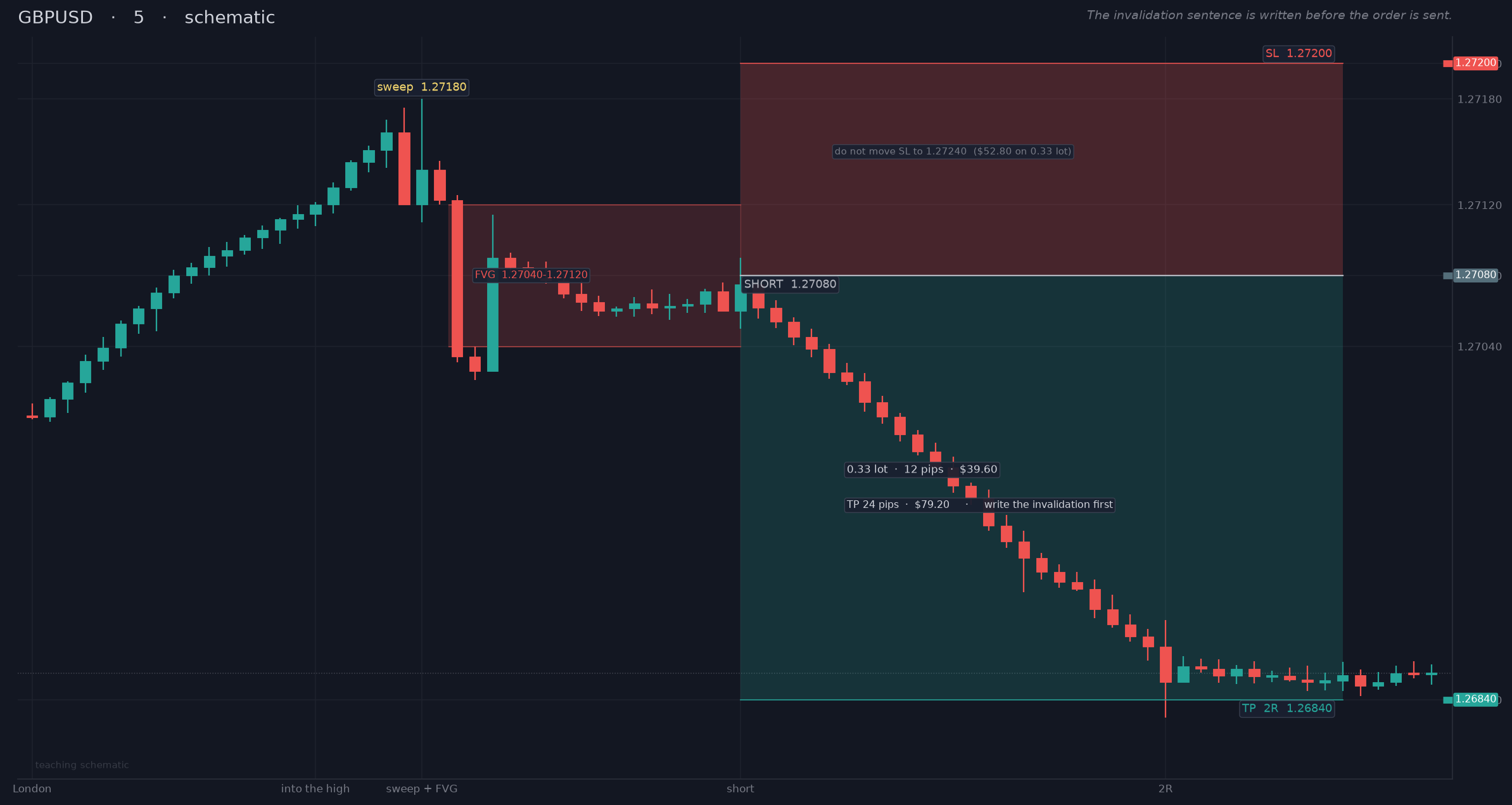
In the schematic I am about to short GBPUSD at 1.27080, from a bearish FVG between 1.27120 and 1.27040: first candle low 1.27120, third candle high 1.27040. The sweep is at 1.27180, so the stop goes at 1.27200, 2 pips past it, which is 12 pips. 0.33 lot is $39.60 of risk. Target 1.26840, 24 pips, 2R, $79.20. Before I send that, I write: this is wrong if M5 closes back above 1.27180, or if the stop at 1.27200 is hit. I will not move the stop to 1.27240 to give it room.
That last sentence is there because 1.27240 would make the same 0.33 lot a 16-pip ticket and $52.80 of risk, which is already through the $40 cap. If I wanted 16 pips I had to choose 0.25 lot before I entered, not after I got uncomfortable.



