The USDCAD spread at the moment I send the order is the only spread that matters. An average I remember from last week, or the 1.2-pip quote I saw at the London open, does not price a fill I am about to take now. If the live spread would eat more than a fifth of my stop, I cancel the limit and wait. I would rather miss the level than start a ticket with a fifth of the risk already gone.
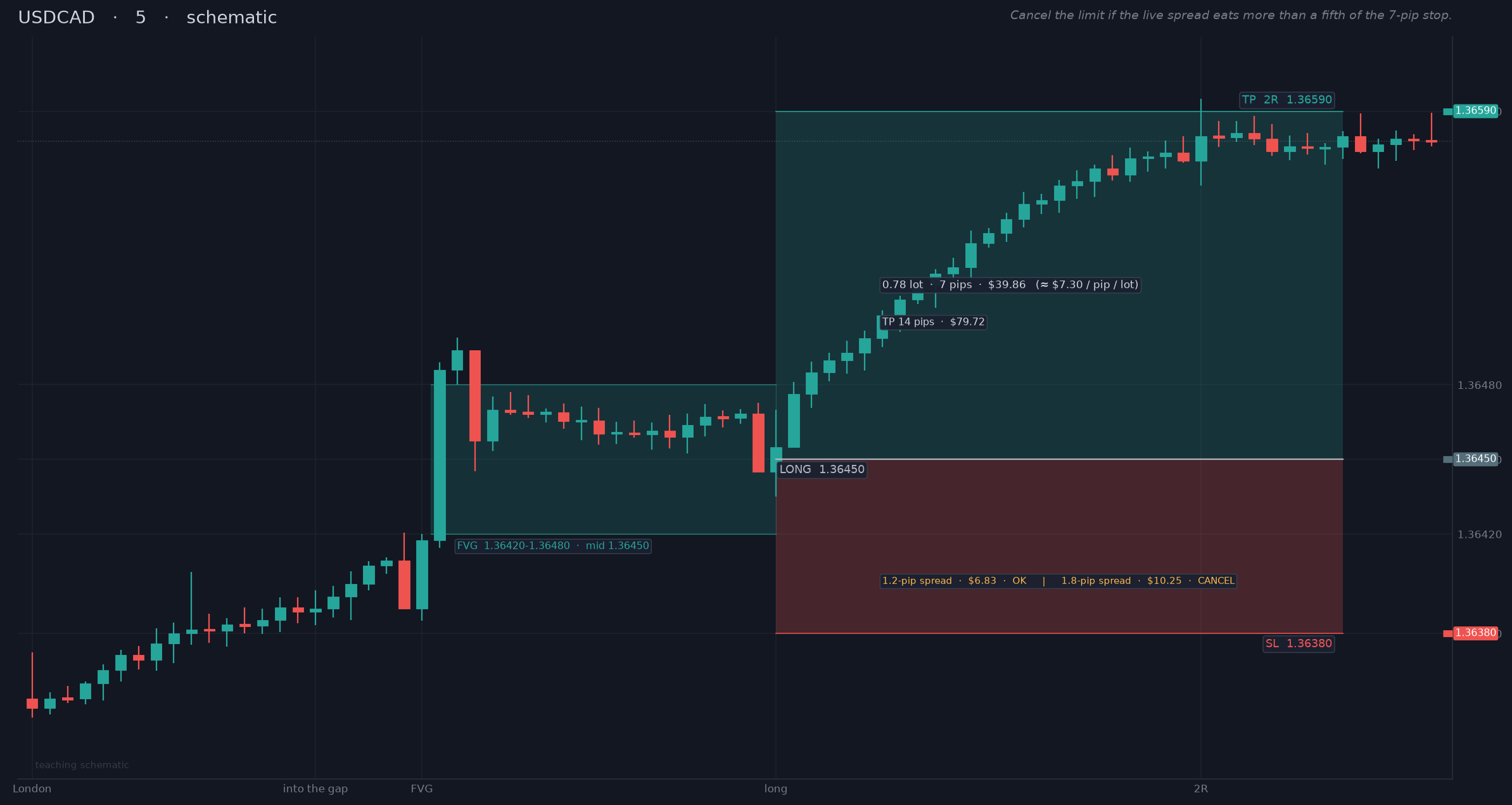
In the schematic a bullish FVG runs from 1.36420 to 1.36480. I would buy 1.36450, with the stop at 1.36380, 4 pips under the gap, which is 7 pips. At about $7.30 a pip per lot, 0.78 lot is $39.86 of risk. Target 1.36590, 14 pips, 2R, $79.72. A 1.2-pip spread is 17% of a 7-pip stop, and it costs $6.83 on 0.78 lot. That is inside my fifth. The fifth of 7 pips is 1.4 pips. If the quote jumps to 1.8 pips, that is 26% of the stop and $10.25 of cost, and I cancel.
I measure this on the bid-ask I would actually get, not on a mid-price line. A 1.8-pip spread on a 7-pip idea is not "a bit messy." It is a different ticket, and I treat it that way by not sending it.

I cancel a USDCAD limit if the live spread would eat more than a fifth of the stop
-
Amanhasnoname
- Posts: 2434
- Joined: Fri Oct 30, 2026 9:45 am
Re: I cancel a USDCAD limit if the live spread would eat more than a fifth of the stop
Tying the spread to the stop rather than to a fixed pip number is a sensible way to frame it, because the same 1.8 pips means something very different on a 7-pip stop than on a 20-pip one. Expressing cost as a share of risk also makes it easy to compare tickets across pairs and sessions, which a remembered average spread never does.
One thing worth checking is how the spread behaves between placing the limit and the fill. A limit sent at 1.2 pips can still fill during a brief widening, for example around a Canadian data release or the oil inventory numbers that often move CAD, so it helps to know when those hit and either pull resting orders before them or accept that the fifth rule only covers the moment of sending.
It is also worth logging the realised spread on each fill next to the quoted one. Over a few weeks that shows whether certain hours, like rollover or the gap between the London close and Asia, regularly push USDCAD past your threshold, which can save a lot of cancelled setups simply by not hunting the pair at those times.
Re: I cancel a USDCAD limit if the live spread would eat more than a fifth of the stop
I check the spread in the second before I send, not from a number I wrote down at 08:00. USDCAD can be 1.2 pips at the London open and 1.8 pips an hour later for no reason that shows up on my M5 candles. The 1.2-pip cost on 0.78 lot is $6.83, which I can live with on a $39.86 stop. The 1.8-pip cost is $10.25, which is already a quarter of the risk, and I would be starting the trade a quarter of the way to being wrong. A remembered average of "about a pip and a bit" would have let that 1.8 quote through. The live quote would not.
It’s Fairman 

