My gold stop distance is not the distance I see on the chart. On a short, the chart shows the bid, but my stop is a buy order and it triggers on the ask. With a 30-cent spread, the bid only needs to get within 30 cents of my stop line for me to be taken out. So I add the spread to the distance first and size from the bigger number.
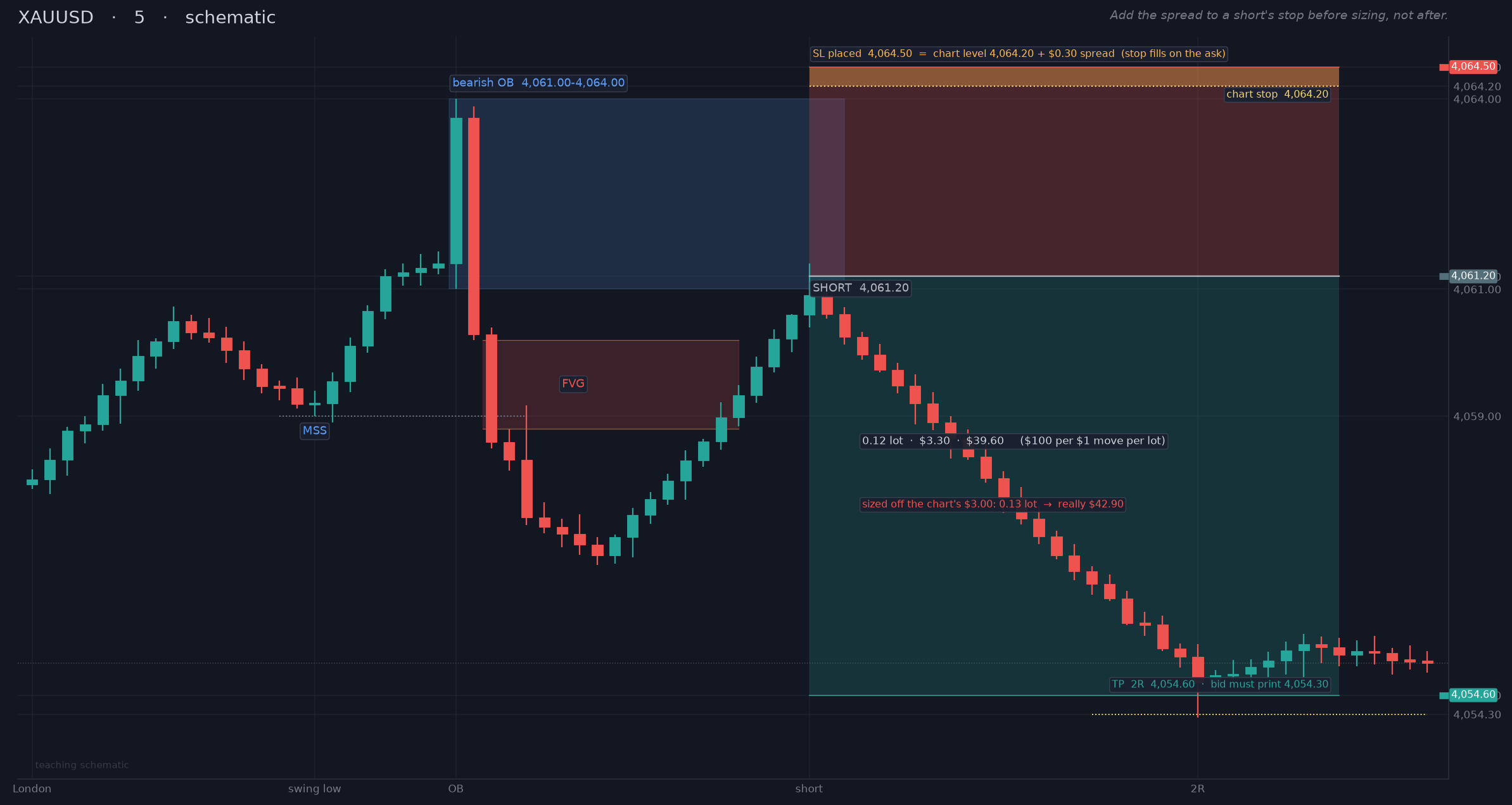
The schematic is a bearish order block from 4,061.00 to 4,064.00 after an MSS on M5. I sell 4,061.20. I want the stop to go only if price actually trades above the block, so the chart level is 4,064.20, 20 cents past its top. Because the stop triggers on the ask, I place it at 4,064.50 instead, which is $3.30 from entry. I count gold at $100 per $1 move per standard lot, so 0.12 lot risks $39.60 on my $10,000 account. If I'd sized off the chart's $3.00, I'd have taken 0.13 lot for $39.00, and once the stop moved to 4,064.50 that 0.13 lot would really be risking $42.90. Target 4,054.60, $6.60 below entry, 2R, $79.20.
The target has the same issue in reverse. My take-profit on a short is also a buy, so it fills when the ask hits 4,054.60, which means the bid has to print 4,054.30. I don't move the target to make up for it. I just know the chart needs to go 30 cents further than the line suggests. The spread is part of the trade, and on gold it's big enough that ignoring it changes the risk by more than loose change.

On a gold short I add the spread to the stop before I size, because the stop fills on the ask and not on the chart
Re: On a gold short I add the spread to the stop before I size, because the stop fills on the ask and not on the chart
The 30 cents is my number for a normal London session on my account. It isn't a constant, so I read the actual quote before I size, the same way I look at the clock. If it's 50 cents, the stop goes to 4,064.70, the distance is $3.50, and 0.11 lot is $38.50. I don't keep a spread table in my head for every hour of the day. I read the two prices on the order ticket, subtract one from the other, and add that to the stop. It takes three seconds and it's the difference between risking what I wrote down and risking what I hoped. If the spread is wide enough that the stop looks silly, that's information too, and usually it means I should wait.
It’s Fairman 
Re: On a gold short I add the spread to the stop before I size, because the stop fills on the ask and not on the chart
For a long it works the other way round. I buy on the ask, the chart shows the bid, and my stop is a sell that triggers on the bid. So the stop line on the chart is honest for a long. What's off is the entry. If I click buy with the bid at 4,061.20 and the spread is 30 cents, I'm in at 4,061.50, and a stop at 4,058.20 is $3.30 away, not $3.00. Same correction, different end of the trade. I used to only think about it on shorts because that's where the stop-outs felt unfair, the ones where the chart never touched my line. Both sides have the cost. It just hides in a different place on a long.
It’s Fairman 
Re: On a gold short I add the spread to the stop before I size, because the stop fills on the ask and not on the chart
Why not widen the stop by a round dollar and forget about it? Because then I'm paying for distance I don't need. A $4.00 stop on this short would be 0.10 lot for $40, and the 2R target would sit at 4,053.20, $1.40 further away than 4,054.60. That's $1.40 more that price has to travel for the same R. On an M5 gold scalp, that changes how often the target gets reached. I'd rather add exactly the spread I'm being charged, keep the stop as tight as the structure allows, and size from the true distance. A round number feels safer, but it's just a less accurate number with extra room I'm paying for.
It’s Fairman 
Re: On a gold short I add the spread to the stop before I size, because the stop fills on the ask and not on the chart
The mistake I'm guarding against isn't big on one trade. $42.90 instead of the $39.00 I thought I had is $3.90. But it's systematic. A gold short sized off the chart distance with a 30-cent spread and a $3 stop is about 10 percent bigger than I think, every single time, and that shows up when I add a losing week in R and the dollar figure doesn't match. When the dollars and the R disagree in my journal, the spread is the first thing I check. On gold it usually explains most of the gap, and on forex majors it almost never does, which is why gold gets this extra step and EURUSD mostly doesn't.
It’s Fairman 

