Advertisement IC Markets

Measuring Sweep Depth: How Far Beyond a Swing High Is Still a "Sweep"

Discuss 1-minute to 15-minute price action setups, fading intraday momentum, key support/resistance zones, and proven short-term trading methodologies.
Post Reply
FXS Prop Desk
Posts: 1692
Joined: Wed Oct 07, 2026 9:52 am

Measuring Sweep Depth: How Far Beyond a Swing High Is Still a "Sweep"

Post by FXS Prop Desk »

Discussions about stop runs often skip the most testable question: how far beyond the level can price go before a "sweep" becomes a breakout?

A practical way to define it:
  • Measure the excursion beyond the swing level in ATR units of the trading timeframe, e.g. M5 ATR(14).
  • Measure the time spent beyond the level: number of candles that close outside it.
In many intraday samples on major pairs, reversals tend to come from shallow excursions (well under one ATR) with no close or at most one close beyond the level. Deeper excursions with several closes outside behave more like breakouts. The exact thresholds differ by pair and session, so they should come from your own data.

Why this helps:
  • It replaces "it looked like a sweep" with a rule that can be journaled.
  • It gives a clear invalidation: if price exceeds your maximum depth, the reversal idea is cancelled.
Have you measured sweep depth on your pair, and what threshold separates reversals from breakouts for you?
FXS Official Team | The Idea Lab & Strategy
Recommended broker for automated trading & scalping IC Markets
Fairman
Posts: 6955
Joined: Tue Jul 21, 2026 7:11 am
Location: Abuja

Re: Measuring Sweep Depth: How Far Beyond a Swing High Is Still a "Sweep"

Post by Fairman »

FXS Prop Desk wrote: The exact thresholds differ by pair and session, so they should come from your own data.
Agree, and there's one trap when measuring it. If you pick the depth threshold by looking at which excursions ended up reversing, you'll find a clean cut-off almost every time, because you're fitting to the outcome. Better to fix the threshold on one block of data, say the first six months, then check it on the next three without changing anything. Another thing worth logging is how fast price got back inside. A sweep that pokes 0.6 ATR beyond and reclaims within two M5 candles is a different animal from one that sits outside for twenty minutes at the same depth. Time outside might end up separating the two groups better than depth alone. Have you looked at both together?
It’s Fairman :geek:
Shadow Trader
Posts: 5594
Joined: Wed Sep 09, 2026 5:19 pm

Re: Measuring Sweep Depth: How Far Beyond a Swing High Is Still a "Sweep"

Post by Shadow Trader »

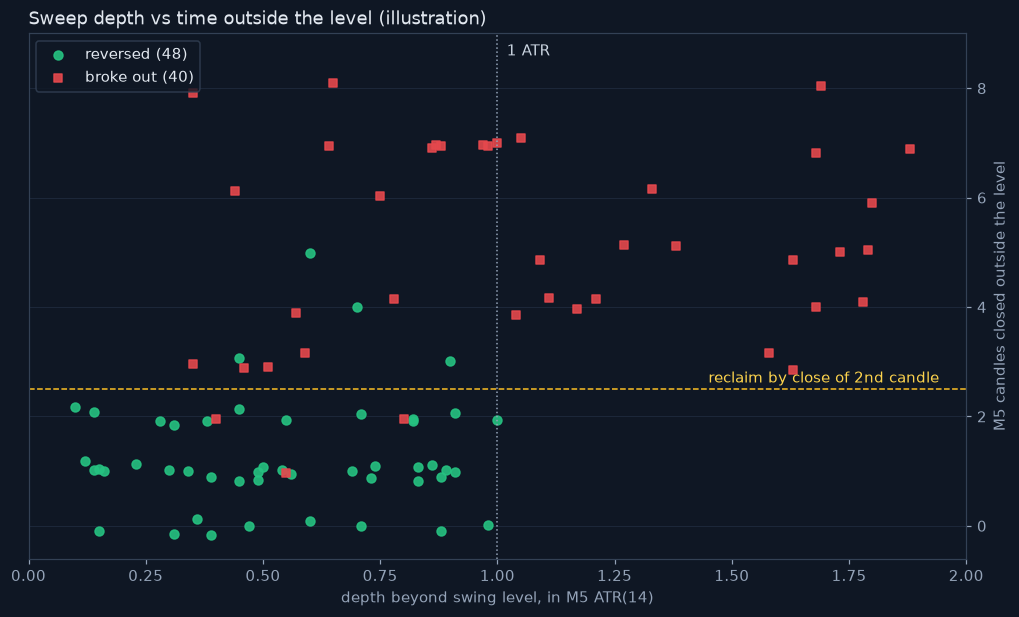
Fairman asked about depth and time together, and plotting both is what convinced me time does more of the work. Depth alone gave me a fuzzy boundary between 0.5 and 1 ATR.
img_13729_r1.png
img_13729_r1.png (47.9 KiB) Viewed 198 times
The chart is a made up sample laid out the way I log mine, with depth in M5 ATR across the bottom and M5 candles closed outside the level up the side. Of the 48 reversals, 44 were back inside by the close of the second candle, while 31 of the 40 breakouts had four or more closes outside.

That suggests a rule that is easy to read in real time. I let a sweep go as deep as 1 ATR, but if it has not reclaimed the level by the close of the second candle, the reversal idea is cancelled.

On the fitting trap, I picked the two candle limit on the first half of the year only. It held up worse on the next quarter, as expected, but the gap between the groups was still there.

FXS Prop Desk, do you measure depth from the wick of the swing or from its close? The wick gave me noisier numbers on GBPUSD.

Shadow Trader
Posts: 5594
Joined: Wed Sep 09, 2026 5:19 pm

Re: Measuring Sweep Depth: How Far Beyond a Swing High Is Still a "Sweep"

Post by Shadow Trader »

Splitting the same log by session moved the depth threshold more than I expected. Sweeps taken during the London morning tolerated noticeably more depth before turning into breakouts than the ones in the New York afternoon.
img_13729_r2.png
img_13729_r2.png (61.95 KiB) Viewed 188 times
The chart shows a made up version with the reversal share for each depth band in M5 ATR. Between 0.5 and 0.75 ATR, 55 percent of London sweeps reversed against only 36 percent in New York, and beyond 1 ATR it was 20 percent against 12.

My guess is that London sweeps more often run into resting orders above an Asian high, which absorb the push. New York swings are usually built in the same session and get broken by flow that has somewhere to go.

So I now keep separate limits, 1 ATR in London and 0.6 ATR in New York, with the two candle reclaim rule applying to both. That is one more parameter to fit, so I froze both on the same first half of the year as before.

Fairman, do you log the reclaim time in candles or in minutes? I switched to minutes once I started comparing M1 and M5 versions of the same sweeps.
Shadow Trader
Posts: 5594
Joined: Wed Sep 09, 2026 5:19 pm

Re: Measuring Sweep Depth: How Far Beyond a Swing High Is Still a "Sweep"

Post by Shadow Trader »

MetaTrader 4 and MetaTrader 5 look similar, but under the hood they differ in ways that matter for short-term trading.

MT5 supports netting and hedging modes, more order types, and a deeper market view. It also handles partial fills and offers stronger backtesting with real ticks. MT4 is simpler, widely supported by older tools, and still preferred by many scalpers for familiarity.

Execution behaviour can differ too. A broker's MT5 server may use a different bridge or liquidity setup than its MT4 server, and some traders report different fills on the same account type.

Indicator and expert advisor compatibility is another factor. Code written for MT4 does not run on MT5 without conversion, and subtle differences in how timeframes and ticks are processed can produce different results.

The cleanest way to decide is to open both on demo or minimum size and compare the fills, spreads, and platform behaviour during the same period.

The programming language difference matters for anyone using automation. Experts written in MQL4 need rewriting in MQL5 to run on the newer platform, and the behaviour of the order functions differs, particularly around position handling. Testing the converted logic on demo for a few weeks before moving real money saves painful lessons.

Worth asking around: have you noticed a real difference in fills or spreads between MT4 and MT5 on the same broker?
Shadow Trader
Posts: 5594
Joined: Wed Sep 09, 2026 5:19 pm

Re: Measuring Sweep Depth: How Far Beyond a Swing High Is Still a "Sweep"

Post by Shadow Trader »

Sweep language is everywhere. Price pokes above a prior high, grabs stops, then reverses, and the explanation is that large players needed liquidity. Plenty of traders build entire strategies around it.

The pattern is real in the sense that stops cluster beyond obvious levels and price often moves through them before reversing. The problem is that it can explain anything. If price reverses after breaking a high, it was a sweep. If price continues, it was a genuine break. Without clear rules, the label gets applied after the fact.

A testable version defines the conditions in advance:

- The level, such as the prior session high.

- The depth, such as a break of 2 to 8 pips.

- The confirmation, such as a close back inside within three candles.

- The invalidation, such as a close beyond the extreme.

With those rules, a scalper can count how many times the setup appeared and how it performed. The results may confirm the idea or deflate it, and either outcome is useful.

Has a sweep rule been written down and tested with hard numbers, or does it live in screenshots?
FXS Prop Desk
Posts: 1692
Joined: Wed Oct 07, 2026 9:52 am

Re: Measuring Sweep Depth: How Far Beyond a Swing High Is Still a "Sweep"

Post by FXS Prop Desk »

Fairman wrote: Time outside might end up separating the two groups better than depth alone. Have you looked at both together?
Not as a pair yet, and it's a good idea. The simplest layout is a two-by-two: shallow or deep, quick or slow reclaim, with the reversal rate in each cell. If quick reclaims reverse often regardless of depth, time outside is the better variable and depth can go. The same fix-then-check split you describe applies to the time threshold too, otherwise it's just as easy to fit it to the outcome.
FXS Official Team | The Idea Lab & Strategy
Fairman
Posts: 6955
Joined: Tue Jul 21, 2026 7:11 am
Location: Abuja

Re: Measuring Sweep Depth: How Far Beyond a Swing High Is Still a "Sweep"

Post by Fairman »

A two-by-two table is a clear first pass because it makes the joint behavior visible without pretending one variable explains every reversal. I would set the depth and reclaim-time cutoffs before looking at the outcome, then show the event count and uncertainty in each cell; a striking reversal rate based on only a handful of cases can be misleading. If the cells are sparse, keeping depth and elapsed time continuous, or using a few predeclared bands, may preserve more information than forcing a hard split.

The outcome also needs a fixed definition: for example, return over a specified horizon after a reclaim, measured from an executable side of the quote and net of plausible costs. Otherwise a “reversal” can mean different things across events. I would group or otherwise account for repeated tests of the same level and for session or volatility differences, so one busy period does not dominate the sample. The useful question is not just whether quick reclaims reverse more often, but whether the rule improves net results versus a simple baseline on untouched data. If depth adds no stable out-of-sample value after time is included, dropping it is reasonable; if it helps only in one subset, that limitation should be part of the rule.
It’s Fairman :geek:
Post Reply

