Advertisement IC Markets

How do you handle NY open inventory risk

Discuss 1-minute to 15-minute price action setups, fading intraday momentum, key support/resistance zones, and proven short-term trading methodologies.
Post Reply
LondonScalper
Posts: 965
Joined: Sat Sep 05, 2026 7:54 am

How do you handle NY open inventory risk

Post by LondonScalper »

NY open inventory risk — how do you handle it?

Carrying a London scalp into NY open has burned me more than the average loser. Spreads step wider, inventory flushes, and a tidy +0.6R can become −0.4R in a minute while I “just watch.” So I treat NY open as a risk event, not a new playground by default.

Current handling:
  • Default: flat or hard reduce 10–15 minutes before NY cash open if the trade thesis was London-session
  • Exception only if the idea was written as overlap-specific with wider stop budget
  • No adding size into the open print — ever
  • Journal tag: inventory_into_NY when I break this, for shame and stats
Do you flatten by clock, by P&L threshold, or by structure (e.g. only hold if stop is beyond a clear level)? Interested in rules that survive real size, not demo bravery. If I am already in profit and the thesis is done, I take the money before the cash open rather than “giving it room.” Room into NY open is often just donated expectancy.
Recommended broker for automated trading & scalping IC Markets
Shadow Trader
Posts: 5594
Joined: Wed Sep 09, 2026 5:19 pm

Re: How do you handle NY open inventory risk

Post by Shadow Trader »

The +0.6R turning into minus 0.4R in a minute is exactly the case I'd use to argue for clock over structure. In most of those, the stop is never touched, so a structure rule says hold, and you sit through the flush feeling disciplined while the trade dies.

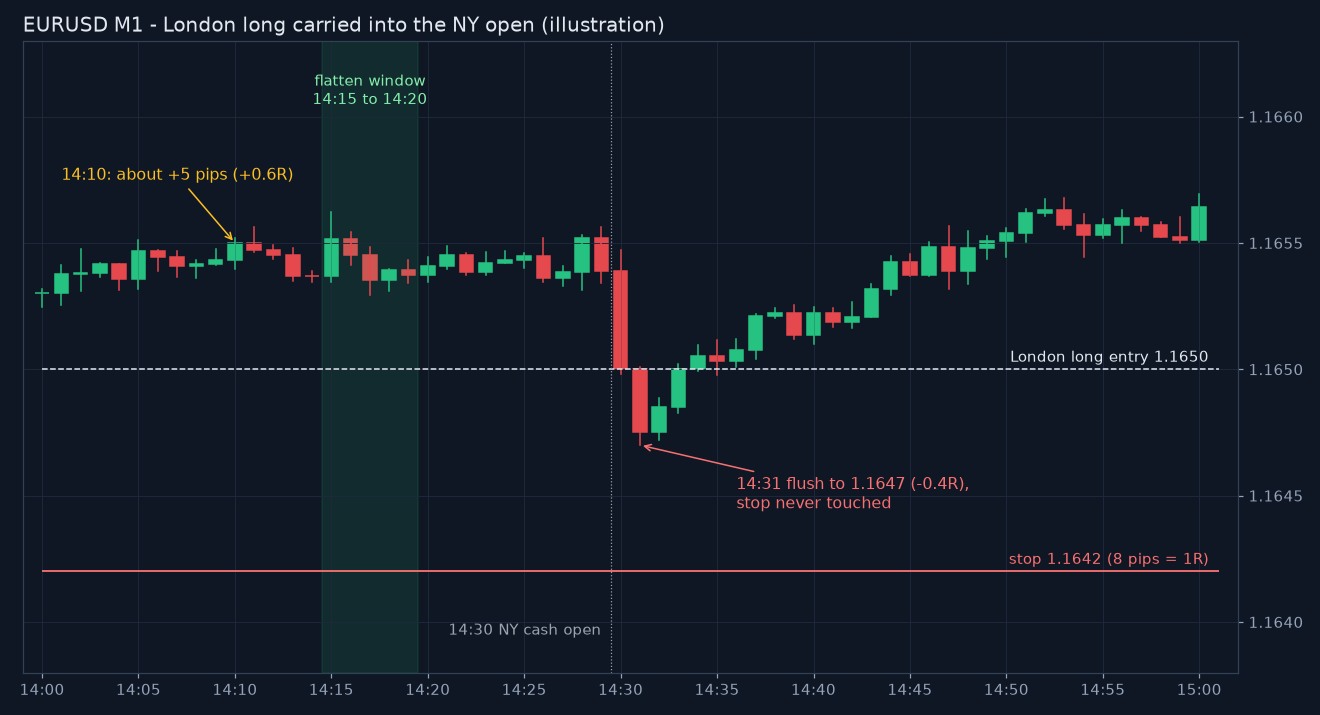
The attached chart is an illustration of that situation: a London long from 1.1650 with an 8 pip stop at 1.1642, up about 5 pips at 14:10, then flushed to 1.1647 within two minutes of the 14:30 open. Nothing about the London idea changed between those two prices.
img_12517.png
img_12517.png (69.32 KiB) Viewed 111 times
In that picture the stop survives and the trade even recovers later, which is why the structure argument is tempting. But the question at 14:15 is whether the London thesis still needs that room, and almost always it doesn't.

I flatten by clock at 14:15 for London ideas, with your overlap exception. The only structure condition I accept is a stop beyond a level that existed before London, and even then I take half off.

One more risk window worth adding is 15:00 London, when the US data at 10:00 New York lands. Do you treat that as part of the same NY open risk or as a separate event?

Fairman
Posts: 6955
Joined: Tue Jul 21, 2026 7:11 am
Location: Abuja

Re: How do you handle NY open inventory risk

Post by Fairman »

LondonScalper wrote: So I treat NY open as a risk event, not a new playground by default.
It might help to split NY open into the three things it usually means, because they need different rules. 13:30 London is the US data, 14:30 is the equity cash open, and 15:00 is the New York option cut plus a second batch of data on some days. If the rule is to be flat 10 to 15 minutes before the cash open, the check happens at about 14:15, after the 13:30 data has already had its go. On data days the London trade still open at 13:25 is the one that needs the decision. On clock versus P&L versus structure, clock rules are the easiest to keep honest because P&L thresholds get renegotiated in the moment. Structure works if the stop is already beyond a level the move would have to break, but then the size has to be set for that distance.
It’s Fairman :geek:
Shadow Trader
Posts: 5594
Joined: Wed Sep 09, 2026 5:19 pm

Re: How do you handle NY open inventory risk

Post by Shadow Trader »

Fairman, splitting NY open into 13:30 data, 14:30 cash open, and 15:00 option cut plus late data is the framing I needed. My old 14:15 flatten rule was really only protecting the cash open, and it left London inventory sitting through the 13:30 print on data days.

I now decide at 13:25 on any day with US tier-one releases. If the London thesis was not written as a data hold, I am flat before 13:30, not waiting for the 14:15 check.

On quiet days with no 13:30 print, the 14:15 clock still stands for London ideas, with the overlap exception you both described. The 15:00 window gets its own five-minute reduce rule when options expiry and a second data batch land together.

Clock stays easier to keep honest than a P and L threshold. I stopped renegotiating plus 0.5R exits the hard way.

LondonScalper, I am splitting the journal tag by which clock bit me rather than one inventory_into_NY bucket. Curious whether you keep one tag for all three windows or already split them.
Shadow Trader
Posts: 5594
Joined: Wed Sep 09, 2026 5:19 pm

Re: How do you handle NY open inventory risk

Post by Shadow Trader »

Risk reversals measure the price difference between calls and puts for a currency pair. A positive number for EURUSD means calls cost more, which suggests traders want protection against a rising euro. A negative figure points the other way.

They're not a prediction tool, but they say something about positioning. When risk reversals move quickly in one direction ahead of an event, hedging demand is changing, and dealers who sold those options have to adjust.

For scalpers, the link is indirect. Dealer hedging flows can add to intraday moves, especially when spot approaches a strike with large open interest. The result is often called gamma pinning or acceleration, depending on the position.

Anyone who has seen price slow down near a big strike and then accelerate after crossing it has probably seen this at work.

Data on risk reversals comes from banks and financial data services, and it isn't always free. Still, even a rough sense of whether the options market leans one way or another adds context that charts don't provide.

Free sources show indicative risk reversal levels, usually delayed. For short-term work the level matters less than a sharp change in it, which hints that hedging demand shifted and that dealers may need to adjust positions in the spot market.

Is anyone using options market data as an input for short-term decisions?
Post Reply

