Advertisement IC Markets

Rollover Spread Spikes and Prop Accounts: A Hidden Drawdown Risk

Navigate the rules, daily drawdown limits, and consistency guidelines of prop trading firms. Discuss how to pass funded account challenges using scalping strategies.
Post Reply
FXS Prop Desk
Posts: 1689
Joined: Wed Oct 07, 2026 9:52 am

Rollover Spread Spikes and Prop Accounts: A Hidden Drawdown Risk

Post by FXS Prop Desk »

Around the daily rollover (usually 17:00 New York), liquidity drops and spreads widen sharply, sometimes to 10–30 pips on minor pairs for a few minutes.

Why this matters on a prop account:
  • Equity is calculated using the bid/ask, so a wide spread instantly reduces floating equity.
  • Stops placed close to price can be triggered by the spread alone.
  • If equity-based drawdown is checked on every tick, a spike can breach an account that would have survived a normal spread.
Precautions:
  • Be flat or well away from the floor before rollover.
  • Avoid tight stops on crosses through the rollover window.
  • Check how the firm handles spread spikes: some firms ignore obvious feed anomalies, many do not.
Has a rollover spread spike ever hit a stop or a drawdown limit on one of your accounts?
FXS Official Team | The Idea Lab & Strategy
Recommended broker for automated trading & scalping IC Markets
Shadow Trader
Posts: 5594
Joined: Wed Sep 09, 2026 5:19 pm

Re: Rollover Spread Spikes and Prop Accounts: A Hidden Drawdown Risk

Post by Shadow Trader »

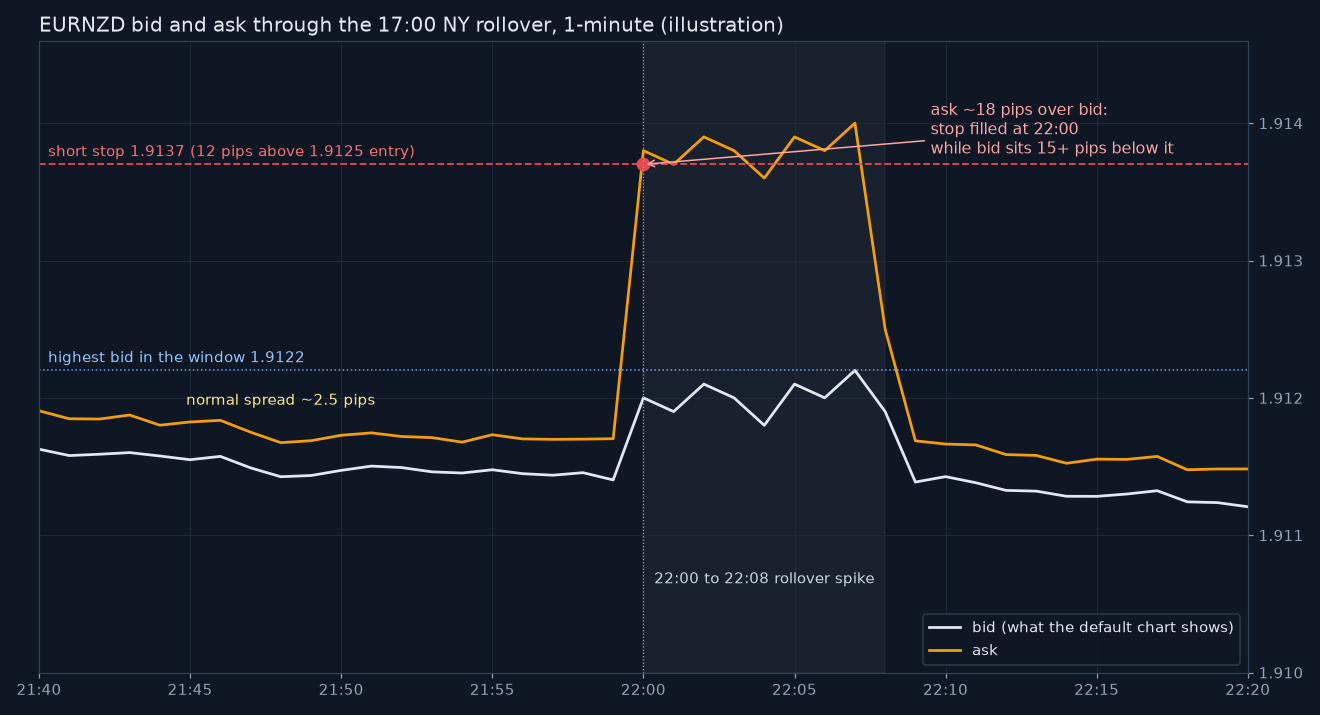
The detail that catches most people is that the chart doesn't show it. MetaTrader draws bid candles by default, so a short gets stopped by the ask while the candle on screen never comes near the stop.

I sketched the typical shape on EURNZD in the attached illustration. Normal spread is around 2.5 pips, then from 22:00 London the ask jumps to roughly 18 pips above the bid for about eight minutes, and a short with a 12 pip stop at 1.9137 gets filled while the bid never trades above 1.9122. Look only at the chart and you'll think someone hunted you, because the stop went 15 pips above the highest bid.
img_13451_r1.png
img_13451_r1.png (101.4 KiB) Viewed 145 times
Two practical things I do. I turn on the ask line on every chart I hold into the evening, and between 21:45 and 22:15 London I don't keep any stop on a cross closer than about three times its normal spread.

The clock moves too. Rollover is 21:00 London instead of 22:00 while the US and UK are on different clocks, and this autumn that week starts on 25 October.

On the drawdown side, does anyone know a firm that spells out how it treats a spread-only breach in its rules? I've only ever seen it decided case by case.

Shadow Trader
Posts: 5594
Joined: Wed Sep 09, 2026 5:19 pm

Re: Rollover Spread Spikes and Prop Accounts: A Hidden Drawdown Risk

Post by Shadow Trader »

FXS Prop Desk, the drawdown check timing matters as much as the spike itself. On one firm equity was marked every tick, so an eight minute rollover on EURNZD that never closed a trade still printed a 0.4% equity dip and sat one tick from the daily floor.

Another firm only checked end of day balance, and the same spike was invisible the next morning. I now ask that question in writing before I fund, because the answer decides whether I must be flat by 21:45 London or can hold a wide stop through the window.

Minors and majors behave differently too. EURUSD on my feed rarely clears 4 pips at rollover, while EURNZD and GBPAUD have printed 15 to 25 more than once this year.

So the flat rule is firm on crosses and softer on the majors, as long as the stop sits outside three times the normal spread. Does your desk treat majors and minors with the same rollover rule, or split them the way the feeds actually behave?
Shadow Trader
Posts: 5594
Joined: Wed Sep 09, 2026 5:19 pm

Re: Rollover Spread Spikes and Prop Accounts: A Hidden Drawdown Risk

Post by Shadow Trader »

A spot FX trade settles two business days later, except for a few pairs like USDCAD, which settle next day. The settlement date, called the value date, is why rollover exists.

A retail trader who holds a position past the daily cutoff, usually 5 PM New York time, has their position rolled to the next value date. The broker does this through a tom-next swap: closing the position for tomorrow's value date and reopening it for the following day. The price difference, determined by the interest rate gap between the two currencies, becomes the swap credit or debit.

On Wednesdays, rollover moves the value date from Wednesday to Monday, covering the weekend, which is why swap is tripled. Around holidays in either currency's country, value dates shift, and swap charges can multiply or behave oddly.

Understanding the mechanics clears up several mysteries. Why swap differs by pair, why Wednesday costs triple, why some days charge extra, and why spreads widen at rollover when liquidity providers adjust.

It also underlines why scalpers avoid holding through the cutoff, unless a position is intentionally part of a longer plan.

Some historians describe Herstatt risk as one of the reasons the interbank market developed credit limits and netting arrangements. The practical legacy shows up in today's cut-off times and the structure of settlement systems, which look arbitrary until the history is known.

Have holiday-related swap charges ever surprised an account, and how are they anticipated now?
Post Reply

