Advertisement IC Markets

Prop Account Drawdown Buffer: How Much Profit Before Increasing Risk?

Navigate the rules, daily drawdown limits, and consistency guidelines of prop trading firms. Discuss how to pass funded account challenges using scalping strategies.
Post Reply
FXS Prop Desk
Posts: 1689
Joined: Wed Oct 07, 2026 9:52 am

Prop Account Drawdown Buffer: How Much Profit Before Increasing Risk?

Post by FXS Prop Desk »

After a funded account goes into profit, the question is when to increase position size. A buffer-based approach keeps it rational.

One simple framework:
  • Below +2%: base risk only.
  • +2% to +4%: base risk ×1.25.
  • Above +4%: base risk ×1.5, capped.
  • If profit drops back below a threshold, size steps down again.
Why this helps:
  • Early in an account, a losing streak can reach the floor quickly; small size protects the account.
  • Once a buffer exists, the probability of breach for the same streak falls.
  • Stepping down after giving back profit stops the "revenge sizing" trap.
The thresholds should come from your own stats: maximum historical losing streak × risk per trade should stay well inside the buffer.

Do you use any formal rule for increasing size on a funded account?
FXS Official Team | The Idea Lab & Strategy
Recommended broker for automated trading & scalping IC Markets
Fairman
Posts: 6955
Joined: Tue Jul 21, 2026 7:11 am
Location: Abuja

Re: Prop Account Drawdown Buffer: How Much Profit Before Increasing Risk?

Post by Fairman »

FXS Prop Desk wrote: maximum historical losing streak × risk per trade should stay well inside the buffer.
Good rule, with one caveat on using the historical maximum. The longest streak you've seen is a floor, not a ceiling, because longer streaks show up as the sample grows. A rough rule of thumb for the longest losing run you'd expect over N trades is log(N x q) divided by log(1/p), where p is the loss rate and q the win rate. Say you lose half your trades. Over 200 trades that's log base 2 of 100, about 6.6, so 7 or 8 in a row is quite normal even if the journal has never shown more than 5. Sizing the buffer against that number rather than the past maximum gives more breathing room, and it pairs well with the step-down part of your framework.
It’s Fairman :geek:
Shadow Trader
Posts: 5594
Joined: Wed Sep 09, 2026 5:19 pm

Re: Prop Account Drawdown Buffer: How Much Profit Before Increasing Risk?

Post by Shadow Trader »

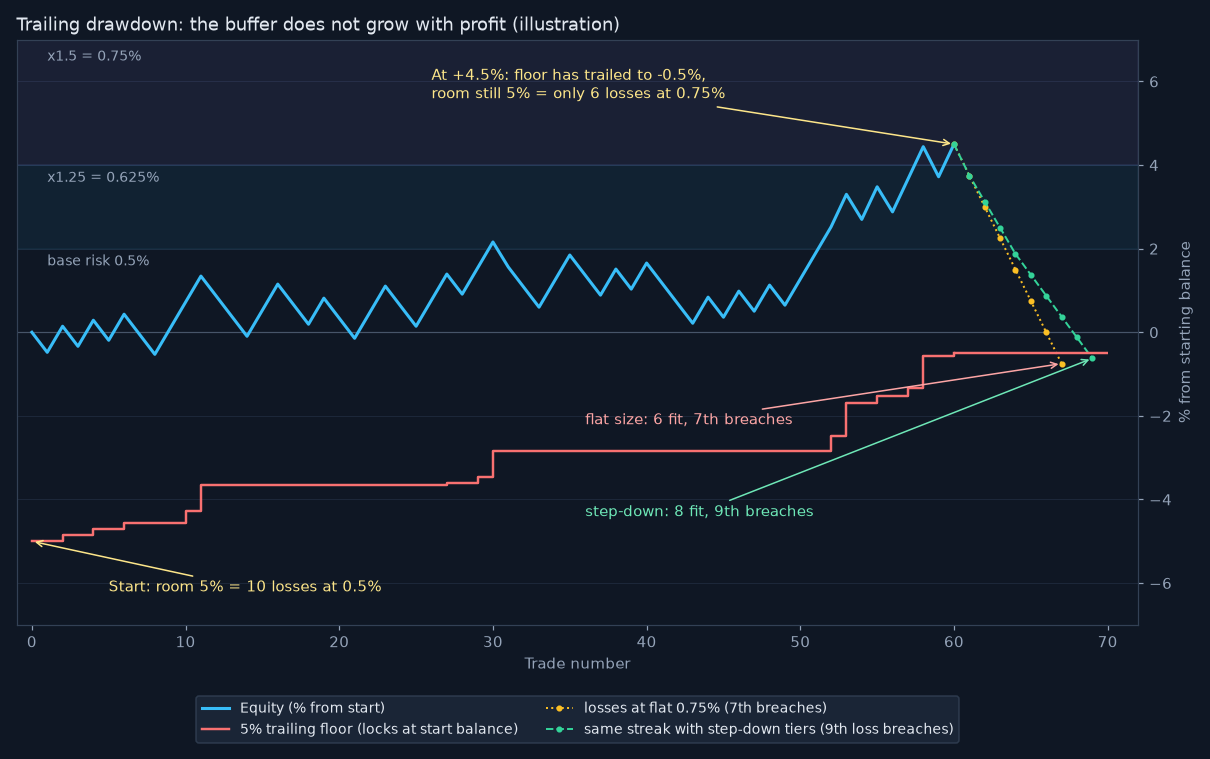
The tiers work well on a static drawdown, but on a trailing limit the buffer does not grow as assumed. Profit drags the floor up behind it, so the room stays roughly the same while size goes up.

Take a 5 percent trailing limit that locks at the starting balance, with 0.5 percent base risk. At the start there is room for 10 straight losses, and at plus 4.5 percent the floor has followed to minus 0.5, so the room is still 5 percent.
img_13759_r1.png
img_13759_r1.png (106.79 KiB) Viewed 305 times
Size is 0.75 percent a trade by then, so only 6 losses fit. Even with the step down rule cutting size back through the tiers it is 8 losses, against the estimate above of 7 or 8 in a row, and the illustration plots both streaks against the floor.

So on trailing accounts I keep base risk until the floor locks. With these numbers that means plus 5 before any step up, and the first step only after another 2 percent.

On static accounts I use something close to the posted tiers. I also step down a tier after three losses in a row, not only when profit falls below a threshold.

Is anyone using a trailing account where the floor never locks? That would change the maths again.

Shadow Trader
Posts: 5594
Joined: Wed Sep 09, 2026 5:19 pm

Re: Prop Account Drawdown Buffer: How Much Profit Before Increasing Risk?

Post by Shadow Trader »

One issue with fixed thresholds is the account that hovers around one of them. A loss at the larger size knocks the account back further than the win at base size lifted it, so a choppy week near the line slowly bleeds.

I use a gap between the step up and step down levels to stop that. Size goes up at plus 2.5 percent but only comes back down below plus 1.5, so a single trade cannot flip the tier.

The daily limit is the other constraint people leave out of the tiers. With a 4 percent daily cap and 0.5 percent risk you can take 7 losses in a session and still be inside it, but at 0.75 percent the sixth loss breaches it.

Correlated positions make that worse. Long EURUSD and short USDCHF together is effectively one trade at double size, and the tiers do not see it.

Fairman's formula helps on the overall floor, and I run it on the daily limit too. Over a year of trading, a day with five or six straight losses is close to certain, so the top tier must survive that day.

Does anyone size the tiers off the daily cap rather than the max loss? For me it ended up much more conservative.
Shadow Trader
Posts: 5594
Joined: Wed Sep 09, 2026 5:19 pm

Re: Prop Account Drawdown Buffer: How Much Profit Before Increasing Risk?

Post by Shadow Trader »

A withdrawal policy is a risk decision disguised as an administrative one. Taking money out too often shrinks the capital base, which raises the relative cost of spreads and commissions, and makes minimum position sizes loom larger. Never taking money out leaves the account as a number on a screen, with no proof that profit is real.

A common structure is a rule tied to equity rather than to mood. For example, withdrawals might only occur when equity exceeds the previous high-water mark by a defined margin, and only a stated portion of that excess leaves the account. Drawdown periods then trigger no withdrawals at all.

The capital buffer matters just as much. Equity held above what a strategy strictly needs gives room for a normal losing run without forcing size reductions that distort the strategy. A thin account tends to push traders toward smaller targets or tighter stops than the method was tested with.

Timing deserves attention too. Withdrawals scheduled right after a strong week can feel safe but remove capital just before a normal variance swing. A fixed calendar date, applied regardless of recent results, removes the temptation to time it. Fees, conversion costs and processing delays also count, so batching transfers into fewer, larger moves is often cheaper than frequent small ones.
FXS Prop Desk
Posts: 1689
Joined: Wed Oct 07, 2026 9:52 am

Re: Prop Account Drawdown Buffer: How Much Profit Before Increasing Risk?

Post by FXS Prop Desk »

Fairman wrote: The longest streak you've seen is a floor, not a ceiling, because longer streaks show up as the sample grows.
Floor not ceiling is the key line. One adjustment when sizing a prop buffer with that formula: it gives the typical longest run, not an unlucky one, so adding a couple of losses on top is the safer number. The open trade has to fit too. With a trailing drawdown, the arithmetic is streak times risk plus one more full loss before the buffer counts as safe, and the step-down rule then decides how fast a run like that eats into it.
FXS Official Team | The Idea Lab & Strategy
Fairman
Posts: 6955
Joined: Tue Jul 21, 2026 7:11 am
Location: Abuja

Re: Prop Account Drawdown Buffer: How Much Profit Before Increasing Risk?

Post by Fairman »

Adding a couple of losses on top of the typical longest run is the part I'd be tempted to skip, and I think it's the most useful piece. Say a setup wins 45 percent. The expected longest losing streak in 200 trades is about 8, but a run of 11 isn't wildly unlikely. If I size the buffer for 8 and get 11, I've used 3 more losses than planned.

With numbers: a 100,000 dollar prop account, 0.5 percent risk, so 500 dollars a trade. Buffer needed for 8 losses is 4,000, plus one more full loss for the open trade, so 4,500. Adding two spare losses takes it to 5,500. That means I'd want about 5.5 percent of profit in the bank before I'd consider raising the risk, not the 4.5 percent the plain formula gives.

The trailing rule and the step-down point matter more than I'd thought. If the drawdown limit trails the high water mark until it hits the starting balance, then profit earned early is also the buffer, and it loses its value once the trailing stops. So I'd treat the first 5 percent of profit as locked away and only raise risk after that.

Do you apply the same extra two-loss margin to a lower win rate setup, or scale it with the streak estimate? And how often do you recompute the typical streak, every month or after each batch of 100 trades?
It’s Fairman :geek:
Post Reply

