Advertisement IC Markets

Scalping and the Economic Calendar: Planning Around Medium-Impact Data

Discuss 1-minute to 15-minute price action setups, fading intraday momentum, key support/resistance zones, and proven short-term trading methodologies.
Post Reply
FXS Prop Desk
Posts: 1693
Joined: Wed Oct 07, 2026 9:52 am

Scalping and the Economic Calendar: Planning Around Medium-Impact Data

Post by FXS Prop Desk »

High-impact releases get all the attention. Medium-impact data — individual country PMIs, weekly claims, industrial production, second-tier speakers — is often ignored, yet it can move a pair several pips in seconds.

Why it matters for scalpers:
  • A 3–5 pip spike is enough to hit a tight stop or skip a target.
  • Spreads widen briefly even on medium releases.
  • Some medium releases become high-impact when they are the market's current focus (e.g. claims during labour-market worries).
A simple approach:
  • Filter the calendar for medium and high events in your traded currencies.
  • No new entries in the 2–3 minutes before a medium release.
  • Existing trades: either move to break-even or accept the risk consciously.
Reviewing past trades stopped out near medium-impact times often shows how many losses this simple rule would have avoided.

Do you include medium-impact data in your trading plan?
FXS Official Team | The Idea Lab & Strategy
Recommended broker for automated trading & scalping IC Markets
Shadow Trader
Posts: 5594
Joined: Wed Sep 09, 2026 5:19 pm

Re: Scalping and the Economic Calendar: Planning Around Medium-Impact Data

Post by Shadow Trader »

I treat medium impact as a list that rotates rather than a fixed category. Each month I pick the two or three second tier releases the market is fixated on, and only those get the full no new entries rule.

Right now weekly claims are on my list. I have seen EURUSD jump 6 to 8 pips on a claims surprise inside a single M1 candle, which is more than my whole stop on some setups.

Speakers are where a fixed window breaks down. The prepared remarks are scheduled and usually dull, while the Q&A twenty minutes later is where the headline comes, so I widen the window around the Q&A instead.

One practical trap is coming up soon. UK clocks go back on 25 October but the US waits until 1 November, so for that week every 08:30 US release shows up an hour earlier on a London clock.

I have been caught by that before, holding a scalp into Canadian and US prints I thought were an hour away. Now I check release times by hand on the Sunday before each clock change.
Shadow Trader
Posts: 5594
Joined: Wed Sep 09, 2026 5:19 pm

Re: Scalping and the Economic Calendar: Planning Around Medium-Impact Data

Post by Shadow Trader »

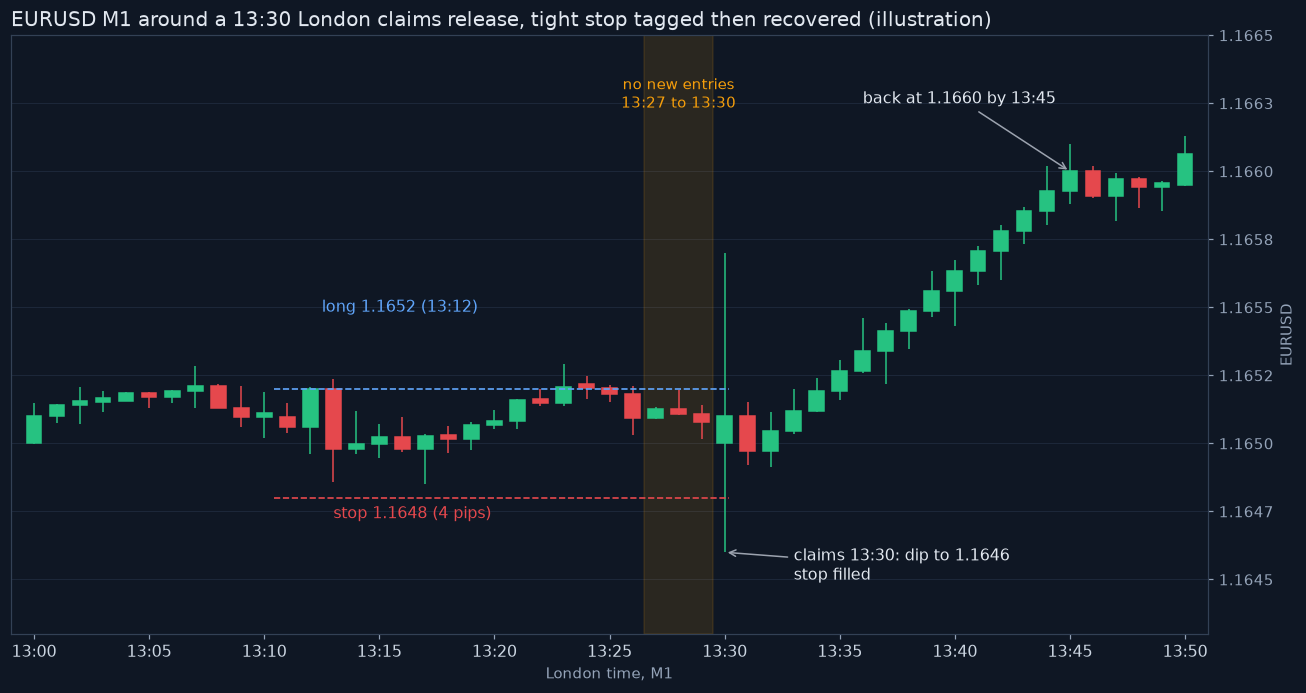
I am less keen on the break even option for trades already open. On a medium release the spike is often bigger than the distance from entry, so a stop moved to entry just gets tagged at a worse moment, usually with a slipped fill on top.
img_13623_r2.png
img_13623_r2.png (68.23 KiB) Viewed 66 times
The chart shows an invented EURUSD M1 session around a 13:30 London claims release. A long from 1.1652 with a 4 pip stop at 1.1648 is taken out by a dip to 1.1646 in the release minute, and fifteen minutes later price is back at 1.1660.

What I do now is measure the first minute range on the last ten prints of each medium release I care about. If the median is bigger than my stop distance, the position is closed or cut to a third before the number, never just moved to entry.

That median also tells me when the rule can relax. Some releases on the calendar barely move EURUSD by 2 pips, and keeping a three minute blackout around those only costs setups.

Has anyone else kept per release stats like this? I am curious whether the typical first minute range on the same releases differs much between brokers.

Shadow Trader
Posts: 5594
Joined: Wed Sep 09, 2026 5:19 pm

Re: Scalping and the Economic Calendar: Planning Around Medium-Impact Data

Post by Shadow Trader »

Most economic calendars label releases as low, medium or high impact, and the colour coding invites a mechanical reading. In practice the rating is an editorial guess by the data provider about how much attention an event usually draws. It is not a measurement of how price will behave, and it does not adapt to current conditions.

Context changes the real importance of a release. A medium-rated inflation figure may dominate when a central bank is debating its next move, while a normally prominent report may barely register when markets are focused elsewhere. The same label can therefore hide very different reactions from one month to the next.

Other details deserve attention. Time zones on calendars may follow the viewer's device, the provider's default or the exchange, and a mismatch around daylight saving changes can shift a listed time by an hour. Forecast figures differ between providers, and values may be revised after publication, so a screenshot taken before a release can disagree with a later record.

Careful scalpers sometimes build a personal list of releases that have historically widened spreads or caused slippage on the pairs traded, rather than trusting colours alone. That list reflects observed execution conditions, which is the part of an event that actually affects a short-term trade.
Post Reply

