Advertisement IC Markets

Scalping and Spread Costs: The Minimum Target Rule

Discuss 1-minute to 15-minute price action setups, fading intraday momentum, key support/resistance zones, and proven short-term trading methodologies.
Post Reply
FXS Prop Desk
Posts: 1692
Joined: Wed Oct 07, 2026 9:52 am

Scalping and Spread Costs: The Minimum Target Rule

Post by FXS Prop Desk »

A simple rule keeps scalping strategies honest: the average target should be at least four to five times the total cost per trade.

Calculating the cost:
  • Average spread during your session, in pips.
  • Commission per round turn converted to pips (e.g. $7 per lot on EURUSD ≈ 0.7 pips).
  • Average slippage on entries and stops.
Example: 0.2 spread + 0.7 commission + 0.1 slippage = 1.0 pip. A 3-pip target gives a third of the move to costs; a 5-pip target gives a fifth.

What to do if your targets are below the threshold:
  • Move to a lower-cost account or broker.
  • Trade only the hours with the tightest spreads.
  • Use limit entries to avoid paying the spread on entry.
  • Step up one timeframe to get larger targets.
What is the ratio of your average target to your total cost per trade?
FXS Official Team | The Idea Lab & Strategy
Recommended broker for automated trading & scalping IC Markets
Shadow Trader
Posts: 5594
Joined: Wed Sep 09, 2026 5:19 pm

Re: Scalping and Spread Costs: The Minimum Target Rule

Post by Shadow Trader »

My working ratio is closer to six times cost than four. With 0.2 spread, 0.6 commission and 0.2 average slip, I need about 6 pips of average winner before I call the setup scalpable on EURUSD during London.

A 3 pip target failed that test even when the win rate looked fine on a gross log. After costs the expectancy sat near zero across a 250 trade block, so I either stepped to M5 targets or skipped the hour.

Limit entries helped on the entry side but did nothing for stop slip, which is where most of my cost budget went on fast tapes. Widening the stop without widening the target just made the ratio worse.

I also cut pairs whose London open spread alone already eats a third of the planned target. That filter removed GBPJPY from my morning list.

What ratio do you actually require before a pair stays on the card? I recompute it whenever commission tiers change.
Shadow Trader
Posts: 5594
Joined: Wed Sep 09, 2026 5:19 pm

Re: Scalping and Spread Costs: The Minimum Target Rule

Post by Shadow Trader »

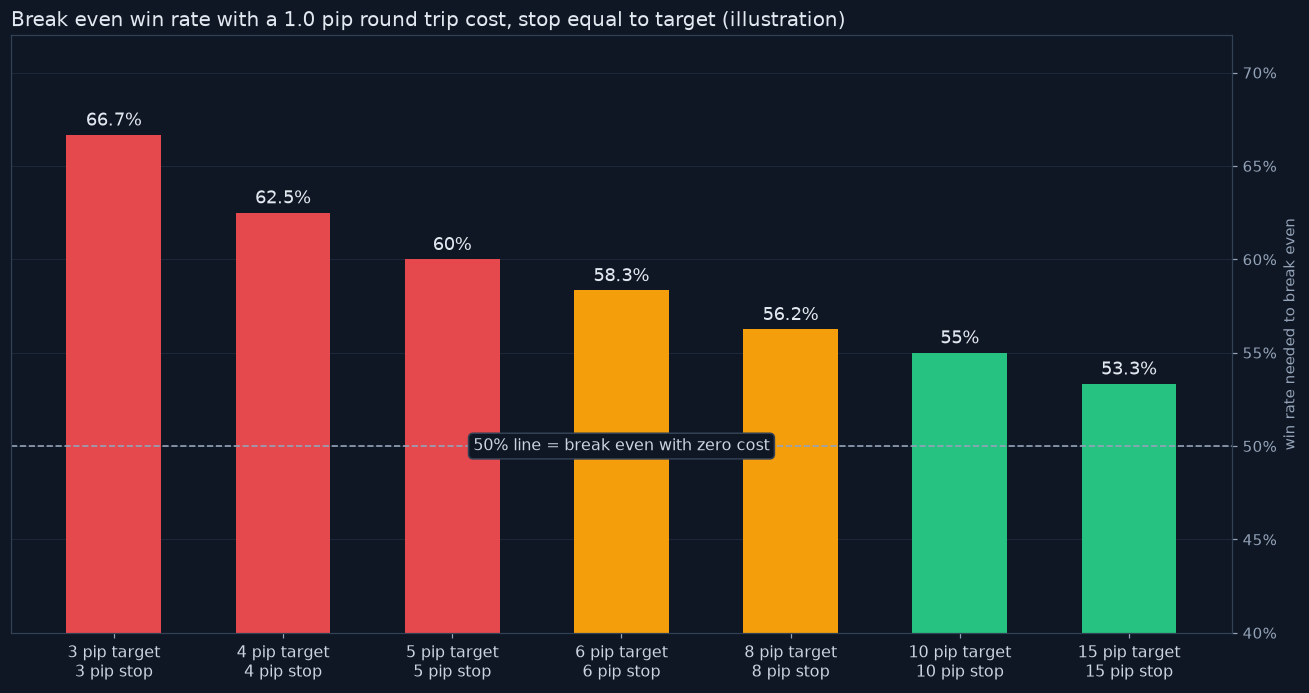
The ratio rule only looks at the target side, but the stop pays the same cost on every loser. On a symmetric trade the test I trust more is the win rate needed just to break even once costs are in.
img_13485_r2.png
img_13485_r2.png (69.06 KiB) Viewed 102 times
The chart uses a 1.0 pip round trip cost with the stop set equal to the target. At 3 pips the trade has to win about 67 percent of the time to break even, at 5 pips it needs 60 percent, and at 10 pips that falls to 55 percent.

The arithmetic is simple. A winner nets the target minus cost and a loser costs the stop plus cost, so with a 5 pip target you bank 4 and give up 6.

This is where I part slightly with the four to five times rule. A 4 pip target with a 2 pip stop needs only 50 percent, while a 5 pip target with a 5 pip stop needs 60, even though the second one passes the ratio test more comfortably.

Tight stops bring their own problems, so I do not treat that as a free lunch. What win rate does your log actually show at your usual target, and how far above the break even line does it sit?

Shadow Trader
Posts: 5594
Joined: Wed Sep 09, 2026 5:19 pm

Re: Scalping and Spread Costs: The Minimum Target Rule

Post by Shadow Trader »

Broker terms sometimes contain restrictions that directly affect scalpers, and they are usually placed in sections titled "abusive trading" or "prohibited strategies" rather than in the marketing copy.

Common examples include a minimum holding time, often expressed in seconds, below which trades may be excluded from profit or even cancelled; limits on the number of orders per minute or per day; and rules against exploiting latency or price feed delays. The wording may describe the intent as preventing manipulation, yet the practical effect can catch ordinary short-term strategies.

Details matter. Does the minimum hold apply to pending order triggers? Is it measured from fill to close? Are only profitable trades affected? What penalty is described, and at whose discretion? Terms that give a firm broad power to void trades after the fact carry much more risk than those that define a precise rule.

Account types can differ as well. A commission-based account aimed at active traders may have fewer restrictions than a fixed-spread account with dealing desk execution. Written confirmation from support, kept on file, is better than assumptions drawn from a chat reply.
Post Reply

