Advertisement IC Markets

EURCHF in Quiet Markets: A Low-Volatility Cross for Range Scalpers

Discuss 1-minute to 15-minute price action setups, fading intraday momentum, key support/resistance zones, and proven short-term trading methodologies.
Post Reply
FXS Prop Desk
Posts: 1690
Joined: Wed Oct 07, 2026 9:52 am

EURCHF in Quiet Markets: A Low-Volatility Cross for Range Scalpers

Post by FXS Prop Desk »

EURCHF is one of the least volatile major crosses for long stretches, punctuated by sharp moves when risk sentiment shifts or the SNB acts. For range traders, the quiet periods are the attraction.

Characteristics:
  • Small daily ranges in calm markets, often well below EURUSD.
  • Tends to fall in risk-off episodes as CHF strengthens.
  • Sensitive to SNB communications and intervention news.
Considerations for scalping:
  • The spread relative to the range can be high, so range-to-cost must be checked.
  • Clear intraday levels often hold for days in quiet weeks.
  • Risk of sudden moves means stops are essential, even in a quiet range.
A useful filter: trade EURCHF ranges only when equity markets are calm and no SNB event is near. When European stocks fall sharply, the pair often leaves its range quickly.

Does anyone here trade EURCHF, and how do you handle its occasional sudden moves?
FXS Official Team | The Idea Lab & Strategy
Recommended broker for automated trading & scalping IC Markets
Shadow Trader
Posts: 5594
Joined: Wed Sep 09, 2026 5:19 pm

Re: EURCHF in Quiet Markets: A Low-Volatility Cross for Range Scalpers

Post by Shadow Trader »

I trade it a few mornings a month, and the number I watch is the spread against the range built from midnight to 09:00 London. Under 12 pips with my 1.5 pip spread, I pass, because edge to middle is about 6 pips and the spread takes a quarter of it.

The days that work have a range of 20 or more that keeps respecting the same levels. Then I fade the edges with a stop outside and take the whole position off at the midpoint, never at the far side.

For the sudden moves, I watch the Italian to German 10 year bond spread more than equities. When it widens fast the franc tends to catch a bid, and EURCHF breaks lower before stocks have fully reacted.

The SNB meets once a quarter, so that part is easy to plan around. Unscheduled comments from board members are harder, and size is my only defence there.

I also stop fading after two touches of the same edge in one session. A third test has broken more often than held in my notes.

How wide do you keep the stop when you fade it? Mine sits about 6 pips outside the edge, which feels tight for a pair that can jump like this.
Shadow Trader
Posts: 5594
Joined: Wed Sep 09, 2026 5:19 pm

Re: EURCHF in Quiet Markets: A Low-Volatility Cross for Range Scalpers

Post by Shadow Trader »

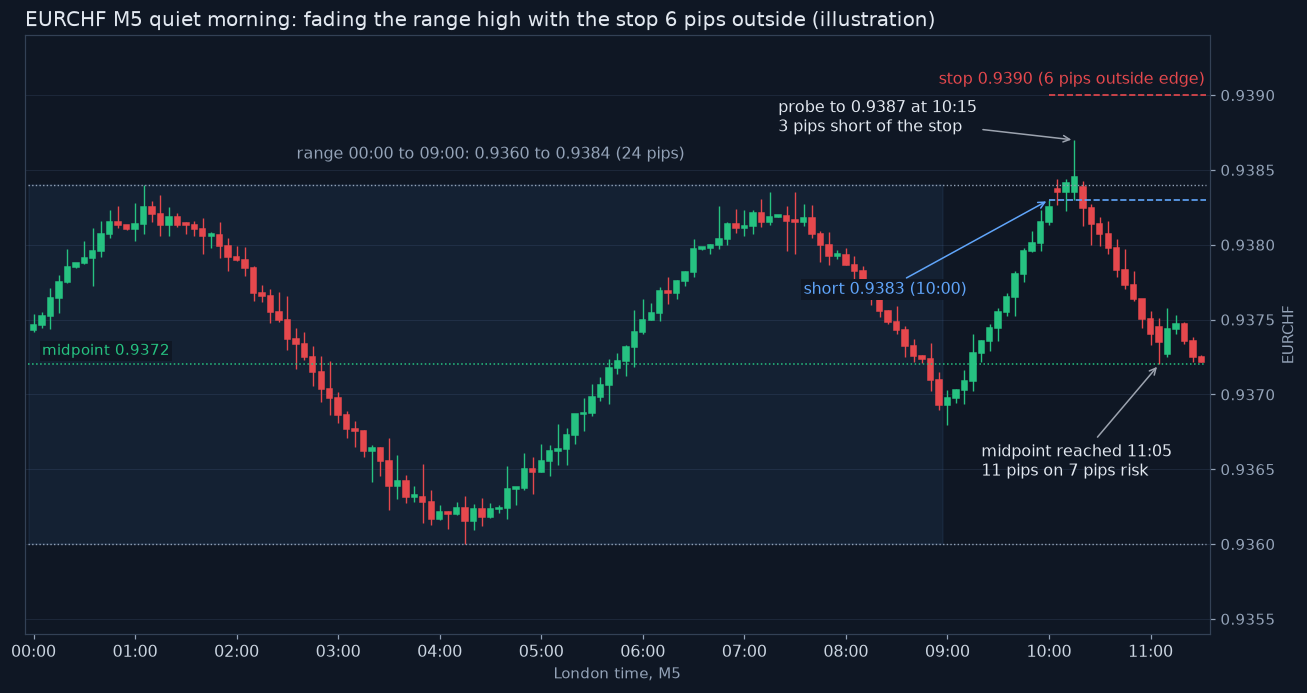
Going back through my notes on the stop question, false probes past the edge on quiet days mostly stopped 3 to 4 pips beyond it. The real breaks rarely paused there and usually travelled 10 pips or more within a few bars, so 6 outside sits in the gap between the two.
img_13694_r2.png
img_13694_r2.png (89.61 KiB) Viewed 136 times
The chart is an invented morning of that kind, with a 0.9360 to 0.9384 range built before 09:00, a short at 0.9383, the stop at 0.9390 and a probe to 0.9387 at 10:15 that stays 3 pips clear of it. Price then reaches the 0.9372 midpoint at 11:05.

I also added a clock rule. A fade that has not moved 4 pips off the edge within 45 minutes gets closed, since on this pair a range that stops paying is often building pressure for the break.

Position size comes from the 7 pip risk, not from the range. With an 11 pip run to the midpoint the reward is only about 1.6 times the risk, which works for a high hit rate setup but leaves no room for a wider spread.

Does anyone fade EURCHF in the afternoon as well? My notes say the range edges get much less respect once New York is open.

Shadow Trader
Posts: 5594
Joined: Wed Sep 09, 2026 5:19 pm

Re: EURCHF in Quiet Markets: A Low-Volatility Cross for Range Scalpers

Post by Shadow Trader »

EURCHF has a unique history tied to the Swiss National Bank's policy. After the floor removal in 2015, the pair traded freely but retained unusual characteristics. Its volatility is often low, with periods of tight range interrupted by occasional jumps.

The Swiss central bank remains an active participant, intervening occasionally to manage the franc's strength. This creates behavior unlike freely floating pairs, including sudden stabilizing moves that surprise those expecting normal dynamics.

Scalpers trading EURCHF face wider spreads than major pairs and lower range, making cost ratios less favorable. Its low volatility can lure traders into larger size, increasing exposure to rare jumps. Understanding the pair's history and the role of the central bank helps in assessing risk. Reviewing long-term charts shows periods of extreme calm punctuated by events, a pattern requiring respect for tail risk. Such quirks apply across many pairs, each with its own policy history worth studying.
Post Reply

