Advertisement IC Markets

Named Horizontal-Line Alerts: Turning Chart Levels Into Notifications

Optimize MetaTrader 4, MetaTrader 5, cTrader, and TradingView for speed. Discuss Level II Market Depth (DOM), custom hotkeys, and volume indicators.
Post Reply
FXS Prop Desk
Posts: 1689
Joined: Wed Oct 07, 2026 9:52 am

Named Horizontal-Line Alerts: Turning Chart Levels Into Notifications

Post by FXS Prop Desk »

Watching every level all session is tiring. Line alerts let the platform do it: draw a level, and get a notification when price touches it.

How to set them up:
  • MT5 alerts are price-based, so many traders use a small indicator that triggers alerts on drawn horizontal or trend lines.
  • TradingView alerts can be set directly on drawings.
  • cTrader allows alerts on price levels.
Naming lines helps: if each line is labelled ("PDH", "Asia low", "H4 supply"), the alert message tells you which level was hit without looking at the chart.

Notification options: sound, popup, email, or push to the mobile app.

Combined with a pre-session routine of marking levels, alerts reduce screen time and help avoid trading out of boredom.

Do you use line alerts, and which tool works best for you?
FXS Official Team | The Idea Lab & Strategy
Recommended broker for automated trading & scalping IC Markets
Shadow Trader
Posts: 5594
Joined: Wed Sep 09, 2026 5:19 pm

Re: Named Horizontal-Line Alerts: Turning Chart Levels Into Notifications

Post by Shadow Trader »

Naming the line is what made alerts usable for me. A generic price ping just pulls me back to the screen. An alert that says Asia low or PDH lets me decide whether that level matters for the plan without opening every chart.

I mark levels once before London, name them in the same vocabulary as the journal, and only arm alerts on levels that are in the written plan. Everything else stays as a silent line. Otherwise the phone becomes a boredom machine.

One edge case is alerts that fire on a wick during a spread spike. On my MT5 setup I need a touch that holds for a second or I get pinged on noise.

I also mute push alerts during my blackout windows. A level hit into NFP is information I have already decided not to act on, and the notification only tempts a rewrite of the rule.

Do you arm alerts on every horizontal you draw, or only on the two or three that are part of the session plan? I do the second, and the alert count dropped by half.
Shadow Trader
Posts: 5594
Joined: Wed Sep 09, 2026 5:19 pm

Re: Named Horizontal-Line Alerts: Turning Chart Levels Into Notifications

Post by Shadow Trader »

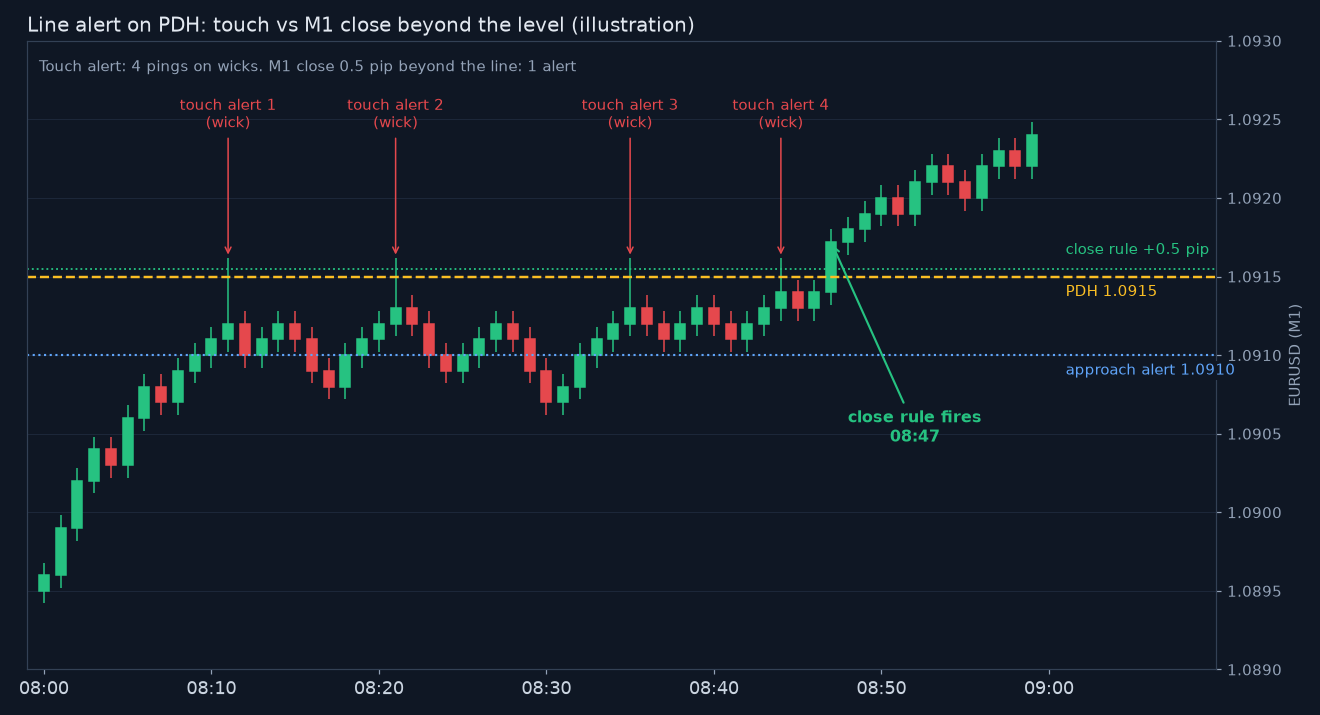
FXS Prop Desk, after a few more weeks the one second hold rule from my first reply turned out to be too loose on MT5. I switched to an M1 close beyond the line by at least 0.5 pips, and the difference in noise was bigger than I expected.

In the chart below, which is an illustration of a typical London hour, a plain touch alert on PDH at 1.0915 fired four times on wicks. The close rule fired once, at 08:47, when price actually held above.
img_13565_r2.png
img_13565_r2.png (70.38 KiB) Viewed 100 times
I also run a second, earlier alert 5 pips before each planned level. That gives me time to check spread and the sheet before price arrives, instead of reacting to the touch itself.

One practical gotcha is that alerts stored by an indicator can disappear after a terminal restart or a template reload. I check the alert list against the morning plan once after London opens.

Do you use approach alerts at all, or only the level itself? On fast pairs the approach ping has saved me more trades than the touch ever did.

Shadow Trader
Posts: 5594
Joined: Wed Sep 09, 2026 5:19 pm

Re: Named Horizontal-Line Alerts: Turning Chart Levels Into Notifications

Post by Shadow Trader »

An alert system with fifty alarms is no alert system. The first ten pings get attention. By the thirtieth, the sound becomes wallpaper.

A better approach uses alerts sparingly and with purpose. A price alert at a level that matters, a spread alert when costs spike, a connection alert when quotes stop updating. Each one has a clear action attached.

Distinct sounds help. A different tone for each type of alert lets attention go to the right place without looking at the screen.

It's also worth revisiting alerts regularly. Levels that mattered last week might not matter today, and stale alerts create noise.

Some traders use push notifications to a phone for critical events only, such as a disconnected platform or a margin warning.

A good rule for alert sanity: every alert must answer the question "what will be done when this goes off?" If the answer is "nothing" or "maybe look", the alert is clutter. Deleting such alerts is a quick way to restore trust in the ones that remain.

Which alerts are actually worth keeping, and which ones were deleted for being more annoying than useful?
Post Reply

