Page 1 of 1
I don't invert a USDCAD FVG on M1 and then trade that inversion on M5. The inversion has to print on the chart I trade
Posted: Mon Nov 23, 2026 8:20 pm
by Fairman
M1 will almost always show me an inversion when USDCAD breaks an M5 gap. I don't trade that sliver on the M5 chart. The inversion has to print on the timeframe I am actually trading. If I am making an M5 decision, I want an M5 close through the old gap and then an M5 imbalance holding from the other side. Otherwise I am importing a lower-timeframe story into a higher-timeframe stop, and the size will not match the idea. An M1 invert can look perfect and still be ordinary noise on the M5 I am actually trading.
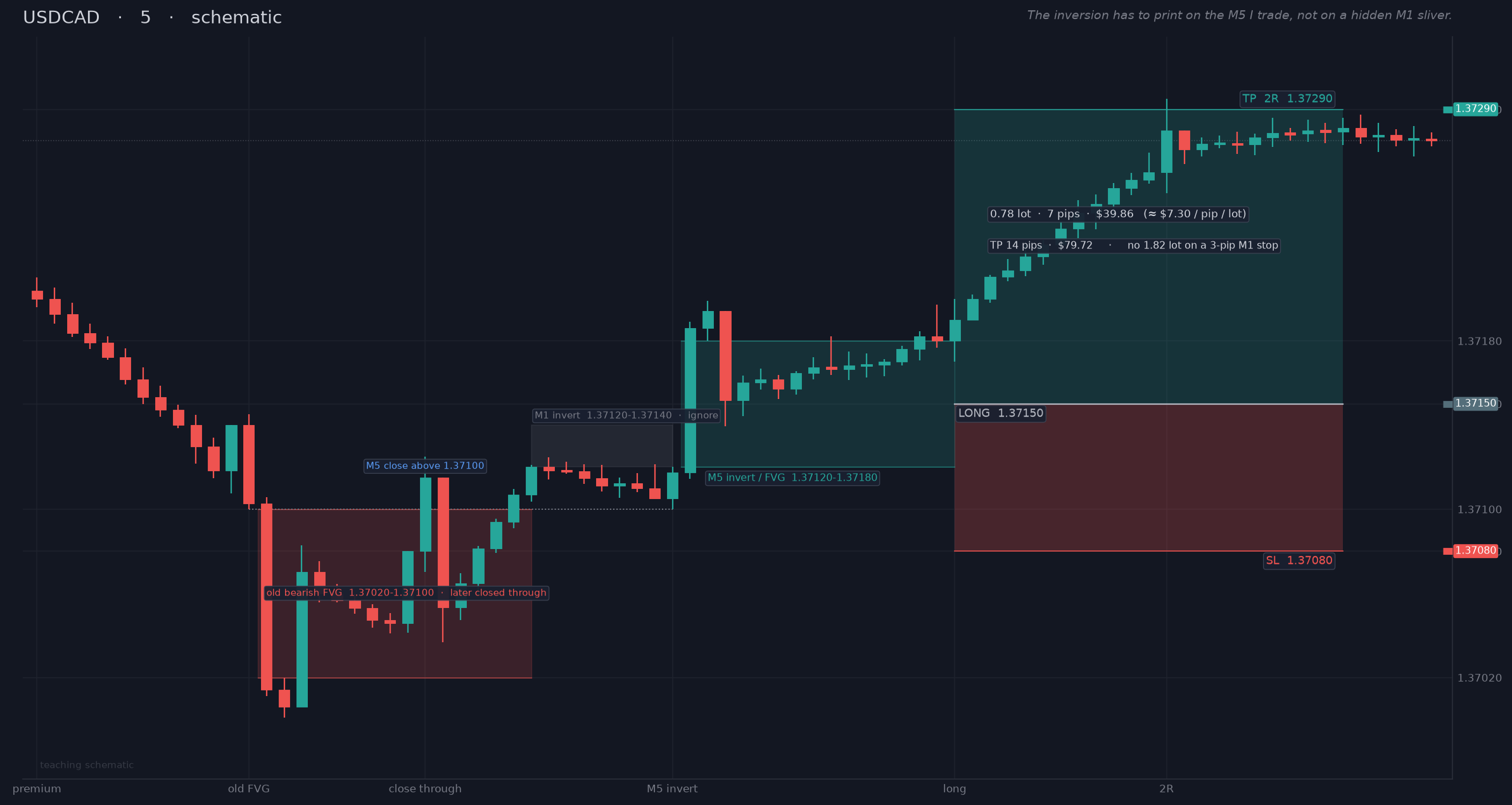
- 11-usdcad-invert-on-traded-tf.png (101.72 KiB) Viewed 69 times
In the schematic the old M5 bearish FVG from 1.37100 to 1.37020 gets traded through and closed above 1.37100. On M1 a tiny invert sits at 1.37120-1.37140. I ignore it. What I would take is a later M5 bullish FVG from 1.37120 to 1.37180: first candle high 1.37120, third candle low 1.37180. Entry 1.37150, stop 1.37080, back under the top of the broken gap at 1.37100, which is 7 pips. At about $7.30 a pip, 0.78 lot is $39.86 of risk. Target 1.37290, 14 pips, 2R, $79.72.
The M1 invert is tempting because a 3-pip stop would let me carry 1.82 lot for $39.86. That is the same dollar risk with the wrong structure under it. A 3-pip breeze on M5 is noise, and I don't want 1.82 lot riding on noise.
Re: I don't invert a USDCAD FVG on M1 and then trade that inversion on M5. The inversion has to print on the chart I tra
Posted: Tue Nov 24, 2026 8:06 am
by Amanhasnoname
The rule of only trading structure that prints on the execution timeframe is a clean way to stop lower-timeframe noise from dictating the stop. Your schematic shows why, because the same dollar risk on an M1 inversion forces a stop of only a few pips, and that sits inside ordinary M5 wicks. A stop should be placed where the idea is proven wrong, and that point belongs to the chart you are actually trading.
Where the M1 view can still help is timing, not structure. You can use it to refine the entry once the M5 gap has formed and price is already reacting, as long as the stop and target stay anchored to the M5 levels. That keeps the reward to risk honest, since a tighter entry only improves the ratio when the invalidation point has not moved.
Since the setup is rule based, it is worth logging each case and tagging whether the M5 gap held or the M1 inversion would have been stopped out by noise. After a decent sample you can see whether the filter really improves expectancy or just removes trades. Also check spread at the time of entry, because a gap that small can lose a meaningful share of the target to costs.
Re: I don't invert a USDCAD FVG on M1 and then trade that inversion on M5. The inversion has to print on the chart I tra
Posted: Tue Nov 24, 2026 8:10 am
by Fairman
Almost every M5 close through a gap hides a tidy M1 invert. If I allow that sliver to count, the filter never says no, and I will be long or short after every broken M5 imbalance. The point of asking for an inversion is to see acceptance from the other side on the chart I trade. Acceptance on M1 is too cheap. I want to see M5 print its own bullish gap at 1.37120-1.37180 and then hold it. Until that happens, the close above 1.37100 is only a break of the old bearish gap, not a finished invert I can buy.
Re: I don't invert a USDCAD FVG on M1 and then trade that inversion on M5. The inversion has to print on the chart I tra
Posted: Tue Nov 24, 2026 11:03 am
by Fairman
I still want that M5 invert to hold from the other side, not just poke through and leave a wick. A single M5 wick through 1.37100 and back is not a hold. I want a close through, then a revisit that stays on the new side of 1.37100, ideally inside the new 1.37120-1.37180 gap. If the first revisit cuts back through 1.37100 and closes back inside the old bearish gap, I don't treat the invert as live. The hold is the part that tells me the broken gap has actually changed role, and I don't skip it just because M1 already looked convinced.
Re: I don't invert a USDCAD FVG on M1 and then trade that inversion on M5. The inversion has to print on the chart I tra
Posted: Tue Nov 24, 2026 2:07 pm
by Fairman
The 3-pip M1 stop is the other reason I refuse it. From 1.37140 with a stop at 1.37110, 3 pips at $7.30 gives a max size of 1.82 lot and $39.86 of risk, the same dollars as my 0.78 lot M5 ticket. It is not the same trade. A 3-pip dip on an M5 chart is well inside ordinary noise around 1.37120-1.37140, and 1.82 lot on that noise turns a routine wick into a full $39.86 loser. I already have a 7-pip stop I trust at 1.37080, back under the top of the broken gap. I don't throw it away for a larger lot on a smaller timeframe.
Re: I don't invert a USDCAD FVG on M1 and then trade that inversion on M5. The inversion has to print on the chart I tra
Posted: Tue Nov 24, 2026 5:04 pm
by Fairman
If a proper M5 invert prints an hour later, I treat it as a new idea. I don't go back to the M1 sliver and say it "called" the later gap. The later gap has its own entry, its own 7-pip stop, and its own 0.78 lot, and it has to be valid at the time I send it. Backdating is how I keep a broken M1 idea alive until the market finally gives me something I can hang a chart on. I'd rather wait for 1.37120-1.37180 to actually exist on M5, even if that means I miss the first bounce off the tiny invert.