Page 1 of 1
I pass a USDJPY long when the stop is twice the displacement that made the shift
Posted: Mon Nov 23, 2026 2:11 pm
by Fairman
A small shift and a wide stop is a shape I used to take, and it is a shape I now pass. If the displacement that broke the USDJPY swing is only half as wide as the stop I need to put beyond the sweep, the urgency I want is not there. I don't shrink the stop to make the numbers match, and I don't take the wide stop anyway just because a gap printed.
- 07-usdjpy-stop-vs-displacement.png (96 KiB) Viewed 92 times
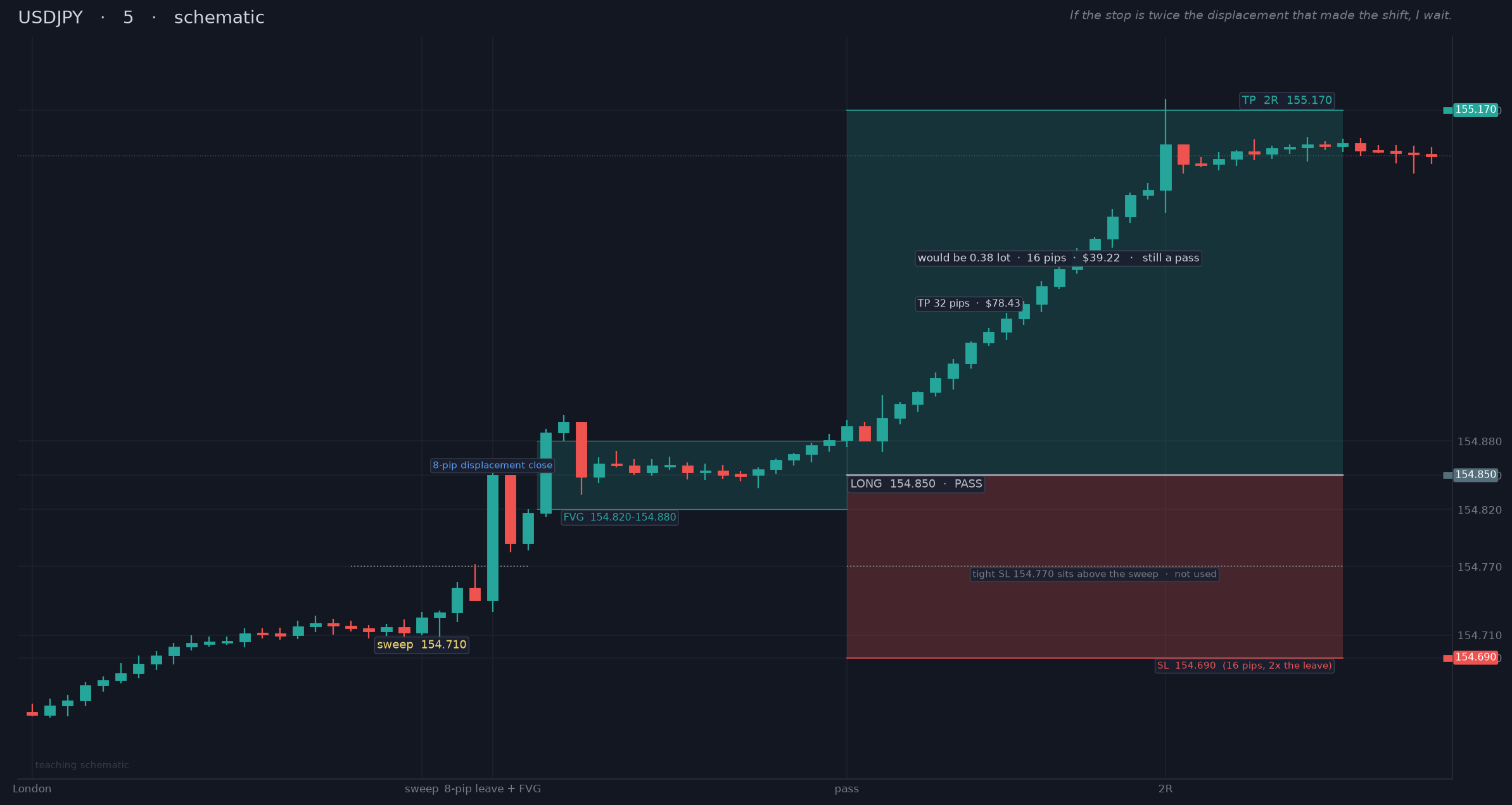
In the schematic the M5 close through the swing is only an 8-pip displacement. A bullish FVG then prints from 154.820 to 154.880: first candle high 154.820, third candle low 154.880. I would buy 154.850, and the logical stop is 154.690, 2 pips under a 154.710 sweep, which is 16 pips. That stop is twice the displacement. The size would be 0.38 lot, $39.22 of risk, target 155.170, 32 pips, 2R, $78.43. I still pass.
If I tighten the stop to 8 pips to match the shift, it sits at 154.770, which is still above the 154.710 sweep. A normal revisit of the sweep would take me out before the idea is actually wrong, and the reward for that tighter stop is a larger lot: 0.77 lot is $39.73. That is how I used to talk myself into the trade. The rule now is simpler. If the stop I need is twice the displacement that made the shift, I wait for a better shift.
Re: I pass a USDJPY long when the stop is twice the displacement that made the shift
Posted: Mon Nov 23, 2026 5:13 pm
by Fairman
I measure the displacement on the same chart I am trading, from the swing that was broken to the close that broke it. In the schematic that close is 8 pips through the old high or low, and that is the number I compare to the 16-pip stop. I don't drop to M1, add up three small candles, and call it a 16-pip displacement. Almost any M5 close hides a more dramatic M1 path, which would make this filter pass every shift on the screen. If the M5 close is 8 pips, the displacement is 8 pips. The 16-pip stop then fails the test, and I don't need a second timeframe to talk me back into it.
Re: I pass a USDJPY long when the stop is twice the displacement that made the shift
Posted: Mon Nov 23, 2026 7:58 pm
by charlotteclark
The timeframe consistency is the right call; switching to M1 after the fact would make almost any M5 shift look valid. One practical check: measure the 8-pip displacement from the swing level to the M5 close, and measure the 16-pip stop from entry including expected spread, not just the raw chart distance. Otherwise the same setup can pass or fail depending on the feed. The 0.38 lot math and the decision to pass are consistent.
Re: I pass a USDJPY long when the stop is twice the displacement that made the shift
Posted: Mon Nov 23, 2026 8:14 pm
by Fairman
A later, larger shift can still become the trade. If a second push closes 18 pips through a new swing and leaves a fresh gap, I will look at that as its own idea, with its own stop beyond its own sweep. I don't backdate the first 8-pip close and say it "counts" because a better candle printed afterwards. The first picture failed my rule. The second picture has to stand on its own, including a stop that is not twice its displacement. That has cost me a fill when the first gap was the only one that got revisited, and I can live with that cost.
Re: I pass a USDJPY long when the stop is twice the displacement that made the shift
Posted: Tue Nov 24, 2026 8:04 am
by Fairman
The tighter 8-pip stop is the version that used to get me in. Stop at 154.770, 0.77 lot, $39.73 of risk, and a 2R at 155.010, 16 pips, $79.46. It looks balanced on a ticket sheet. It is not balanced on the chart, because 154.770 is still above the 154.710 sweep that made the idea. I would be out on a normal probe of the sweep, and I would be out with 0.77 lot instead of the 0.38 lot the real stop required. The larger size is not a bonus. It is what I get in exchange for putting the stop in a place the idea has not yet been proved wrong.
Re: I pass a USDJPY long when the stop is twice the displacement that made the shift
Posted: Tue Nov 24, 2026 10:58 am
by Fairman
This is a twice-as-wide line, not a demand that the displacement and the stop be equal. A 14-pip close and a 16-pip stop I will still look at. An 8-pip close and a 16-pip stop I will not. I picked twice because that was the shape I kept regretting: a weak leave, a wide invalidation, and a lot that only looked reasonable because I had refused to put the stop where it belonged. I don't sit with a calculator looking for 1.9 versus 2.1. If the stop I actually need is about twice the leave that made the shift, I wait.