Page 1 of 1
Two GBPJPY lows are not sell-side liquidity if the first one never attracted a reaction
Posted: Thu Nov 19, 2026 5:08 pm
by Fairman
Equal lows need a story. Two prints at the same price are not enough. On GBPJPY I will see a low at 198.40, then another at 198.42, draw a line under both, and call it sell-side liquidity I can buy a sweep of. If the first low never attracted a reaction, there is no reason to think stops are sitting there. I just drew a line through two quiet prints and gave it a name.
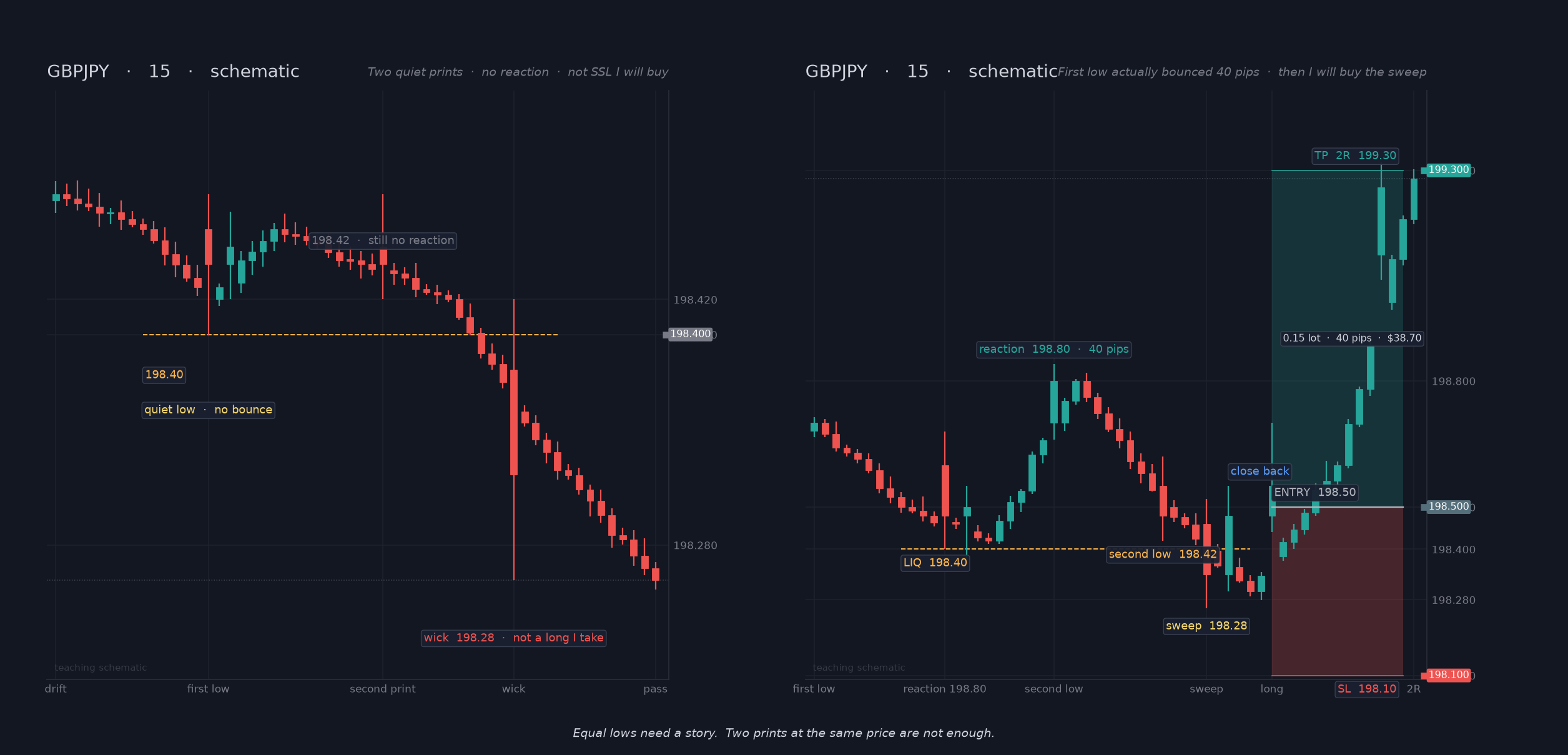
- 15-gbpjpy-reaction-before-ssl.png (141.8 KiB) Viewed 177 times
The left of the schematic is that case: 198.40, a limp drift, then 198.42, no bounce worth measuring off the first low. A later wick to 198.28 does not become a long I will take. The right side is the one I will consider. The first low at 198.40 actually bounces to 198.80, 40 pips, then price comes back, prints 198.42, and later sweeps to 198.28 and closes back. The long is 198.50, stop 198.10, 40 pips, past the sweep, target 199.30, 80 pips, 2R. At a yen rate around 155, a pip is about $6.45 a lot, so 0.15 lot risks $38.70, inside the $40 I allow on a $10,000 account.
I need a reason to believe someone defended the first low. Without that, 'equal lows' is just a horizontal line.
Re: Two GBPJPY lows are not sell-side liquidity if the first one never attracted a reaction
Posted: Thu Nov 19, 2026 7:54 pm
by Amanhasnoname
That distinction is the whole point of liquidity concepts, and it's nice to see it framed by what happened at the first low rather than how neat the line looks. Stops cluster where traders had a reason to enter, and a low that produced a clean 40-pip bounce gave plenty of people that reason. A low that just drifted sideways gave nobody a trade to protect, so there's little to sweep.
One extra filter worth testing is where the first reaction happened. A bounce from a level that lines up with a prior session low, the Asian range, or a round number like 198.50 tends to attract more participation than a random intraday print. Time matters too: a low formed in thin Asian trade on GBPJPY carries less weight than one defended during London.
On the sweep itself, watch for the close back above the level and how quickly it happens. A slow grind back is weaker than a sharp rejection. Also be careful with stop placement on this pair, since 40 pips below entry can still sit inside a normal spike on news days, so checking the calendar before taking these makes sense.
Re: Two GBPJPY lows are not sell-side liquidity if the first one never attracted a reaction
Posted: Thu Nov 19, 2026 8:12 pm
by Fairman
A reaction, for me, is a bounce of a size I would actually mark, or a displacement off the low, not a two-pip tick and a doji. In the schematic the first low at 198.40 runs 40 pips to 198.80, which is enough to suggest someone cared. A 6-pip lift into a thin overlapping range is not. I write the bounce size next to the low when I mark it, so later, when the second print appears, I can see whether the first one earned the line. If I cannot point at that bounce, I don't get to call the second print equal lows, and I don't get to buy the next wick.
Re: Two GBPJPY lows are not sell-side liquidity if the first one never attracted a reaction
Posted: Fri Nov 20, 2026 8:08 am
by Fairman
Clustered lows with real reactions are a different thing from two quiet prints, and they are also different from a messy 8-pip smear I have tried to flatten into a single line. If the lows are 198.36, 198.44, 198.40, each with a bounce, I can treat the cluster as the liquidity, and the sweep has to clear the lowest of them. What I won't do is pick 198.40 because it is a round number inside the smear and then put a 0.15 lot long above it. The reaction is the filter. The neatness of the line is not.
Re: Two GBPJPY lows are not sell-side liquidity if the first one never attracted a reaction
Posted: Fri Nov 20, 2026 11:09 am
by Fairman
On the valid sweep, the stop sits past 198.28, not on it. 198.10 is 18 pips under the wick, and that is why the stop is 40 pips from 198.50, and why the lot is 0.15, $38.70, not 0.20 on a 30-pip stop parked at 198.20. I have had those tighter stops taken by a second probe under a real equal-low line, and then the move I wanted started without me. The close back through the lows is the permission. The extra room past the sweep is the cost of using that permission on a yen pair.
Re: Two GBPJPY lows are not sell-side liquidity if the first one never attracted a reaction
Posted: Fri Nov 20, 2026 2:08 pm
by Fairman
The same test applies to equal highs I want to fade. Two prints at 199.60 are not buy-side liquidity if the first high never sold off. I want a drop I can measure, then a second high, then a sweep and a close back, and only then a short, sized off a stop past the sweep. I have shorted 'equal highs' that were just two quiet ticks at the top of a grind, and there was nothing up there to run except my own order. The name needs a reaction behind it, on both sides of the market, or I leave the line off the chart.