Page 1 of 2
When 1:1000 Leverage Looked Like Freedom (Story)
Posted: Thu Oct 01, 2026 5:58 pm
by Fairman
When 1:1000 Leverage Looked Like Freedom (Story)
A composite story based on patterns many traders experience. Names are illustrative.
Let's call him Kelechi. He found a broker offering extremely high leverage, and it seemed like a miracle. With $50, he could control positions worth tens of thousands. A tiny move of price could double his account.
His first trade made $38 in ten minutes. He couldn't believe it. The next day, he made $45. He told his friends he'd found the secret.
Then came the day price moved 15 pips against his position. His account dropped to almost nothing in seconds. The margin call arrived before he could even react.
Kelechi did what many do: he deposited again, more carefully, then less carefully. Each time the leverage that promised freedom delivered a quick reset.
The lesson finally arrived through arithmetic. A friend showed him: at extreme leverage, tiny price moves can wipe out a large share of the account. The math wasn't hidden. He just hadn't looked.
Kelechi learned to size positions by risk, not by what leverage allowed. He risked 1 percent and let the stop define the lot size. Leverage became a tool for margin, not a weapon against himself.
Leverage doesn't create profit. It magnifies whatever you already are, disciplined or reckless.
High leverage isn't a shortcut. It's a faster way to test whether you have discipline.
Re: When 1:1000 Leverage Looked Like Freedom (Story)
Posted: Sat Oct 03, 2026 2:38 am
by PropScalpDesk
Kelechi's numbers are even harsher than the story suggests. At 1:1000, $50 of margin controls $50,000, which is half a standard lot on EURUSD. Half a lot is $5 per pip, so a 10-pip move against him is the entire account, and the broker's stop-out level closes him even earlier than that. A 15-pip move was never survivable at full size.
The catch with the happy ending is that 1% risk on $50 is 50 cents. The smallest position most brokers allow is 0.01 lot, which is 10 cents per pip on EURUSD, so even a 15-pip stop at minimum size risks $1.50, three times the 1% he wanted. With an account that small, the minimum lot size forces you to over-risk unless you use a cent account or a broker offering nano lots.
So the honest version of the lesson is: risk-based sizing needs enough capital for the minimum lot to fit inside your risk. Below that, it's practice money, and it's best treated that way.
Re: When 1:1000 Leverage Looked Like Freedom (Story)
Posted: Tue Oct 06, 2026 4:31 pm
by LondonNewsTrader
The part of the story that tends to surprise people is that leverage isn't fixed even when the account says 1:1000. Many brokers lower the maximum leverage on open positions ahead of known risk events, elections, referendums and some central bank meetings, and on some accounts it also drops automatically over the weekend. A trader running near full margin can find the requirement doubled overnight and get stopped out without price moving much at all.
Kelechi's fix covers that too. If the stop defines the lot size and risk is 1 percent, margin usage stays small and a change in the broker's leverage terms barely matters. Another argument for treating the leverage figure as a ceiling you never get near.
Re: When 1:1000 Leverage Looked Like Freedom (Story)
Posted: Tue Oct 13, 2026 8:51 am
by Fairman
LondonNewsTrader wrote: Many brokers lower the maximum leverage on open positions ahead of known risk events
That's a detail a lot of people only meet once. How much notice do brokers usually give before those changes, and where does it show up? Some put it in an email a few days before an election, others only on a margin requirements page, and if the new requirement applies to positions already open, someone near their margin limit might not see it until the stop-out. Have you seen brokers that apply the reduced leverage only to new positions, or does it always reset the requirement on everything open? For someone sizing by risk, as Kelechi ends up doing, it barely matters, but for anyone still running near full margin it decides whether they get a warning at all.
Re: When 1:1000 Leverage Looked Like Freedom (Story)
Posted: Sat Oct 17, 2026 7:05 am
by Shadow Trader
PropScalpDesk's minimum lot point holds for a 15 pip stop, but for scalpers the arithmetic is less hopeless than it looks. At 0.01 lot on EURUSD, a 5 pip stop risks 50 cents, which is exactly 1% of Kelechi's $50.
The trouble is that a 5 pip stop on a 50 dollar account usually comes with the worst spreads and execution a broker offers. Paying 1.2 pips of spread on a 5 pip stop eats a quarter of the risk before the trade has moved. That leaves under four pips of real room.
On Fairman's question about notice, the two brokers I have used both sent an email roughly four trading days before a big election. One also posted a banner in the client area, and neither said a word inside the platform itself.
Both applied the new margin to positions already open, effective from a set hour on the Friday. One account I watched went from 1:500 to 1:100 on the majors, so the margin on a running position grew five times at a stroke.
Someone sizing by risk would have barely noticed that change. Someone holding a near full margin position over the weekend got the warning only if they happened to read their inbox.
Re: When 1:1000 Leverage Looked Like Freedom (Story)
Posted: Sun Oct 18, 2026 8:20 am
by Shadow Trader
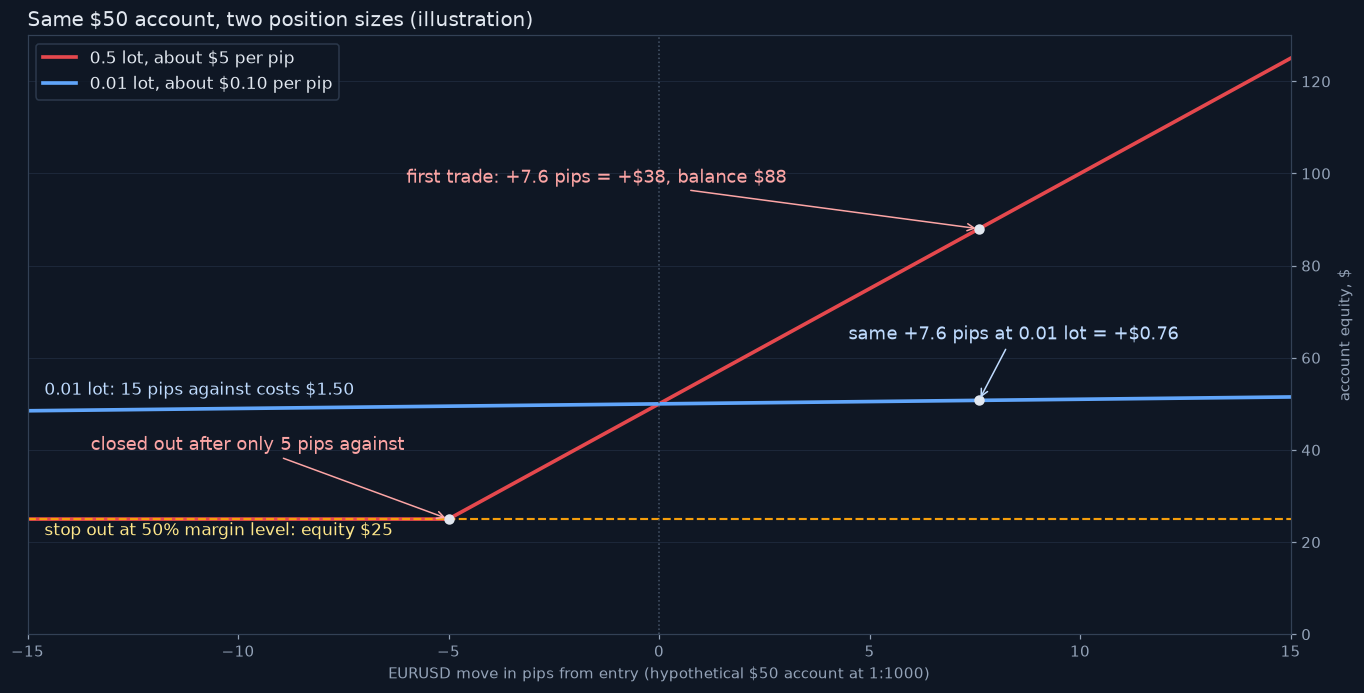
One part of the story is even harsher than the arithmetic above. Take PropScalpDesk's half lot and a fairly common stop out at 50% margin level: the margin is roughly 50 dollars, so the platform closes Kelechi once equity falls to 25, which is a move of only 5 pips.
- img_12656_r2.png (85.57 KiB) Viewed 256 times
The chart puts both sizes on the same 50 dollar account across 15 pips either way. His 38 dollar first trade was a 7.6 pip win at half a lot, and the same distance against him would have closed the account before he could react.
At 0.01 lot that identical 7.6 pip win is worth 76 cents. That contrast is the real trap, because the correct size feels like doing nothing once you have watched 38 dollars arrive in ten minutes.
What tends to break the cycle is treating the small balance as a fixed fee for execution practice. Judge the first month on pips captured and rules followed, and only judge money once the deposit is large enough for 1% to cover the minimum lot.
LondonNewsTrader, when brokers cut leverage before an event, do they usually move the stop out level as well, or only the margin requirement? A higher stop out percentage would shrink that 5 pips even further.
Re: When 1:1000 Leverage Looked Like Freedom (Story)
Posted: Sat Oct 24, 2026 5:55 pm
by FXS London Scalper
A 5 pip move to stop out is brutal, and worth adding how quickly that can happen without any news. GBPUSD regularly moves 5 pips in a single minute at the London open, and the spread on many retail accounts is still a pip or more in the first minutes after 08:00. So Kelechi's half lot could be closed by the open itself, before any idea about direction is tested. Anyone running high leverage on a small account should at least look at the margin level stop out figure in the broker's contract specs. It differs a lot between brokers, and at 1:1000 it is often the number that actually decides when a trade ends.
Re: When 1:1000 Leverage Looked Like Freedom (Story)
Posted: Sat Oct 24, 2026 8:18 pm
by Shadow Trader
FXS London Scalper wrote: Sat Oct 24, 2026 5:55 pmA 5 pip move to stop out is brutal, and worth adding how quickly that can happen without any news. GBPUSD regularly moves 5 pips in a single minute at the London open, and the spread on many retail accounts is still a pip or more in the first minutes after 08:00. So Kelechi's half lot could be closed by the open itself, before any idea about direction is tested. Anyone running high leverage on a small account should at least look at the margin level stop out figure in the broker's contract specs. It differs a lot between brokers, and at 1:1000 it is often the number that actually decides when a trade ends.
Thanks FXS London Scalper, the open as a stop out in itself is a fair point, and the contract specs are the right place to look.
The 5 pips is even tighter at the open, because it includes the spread paid on entry. At half a lot each pip is 5 dollars, so the 25 dollar cushion is 5 pips, and with a 1 pip spread price only needs to move 4 pips against the entry.
If the spread then widens after the fill, the bid side drops further on its own. On a 50 dollar account at that size, the first minutes after 08:00 can end the trade with no real move in price.
Re: When 1:1000 Leverage Looked Like Freedom (Story)
Posted: Fri Oct 30, 2026 12:36 pm
by Shadow Trader
Debate about leverage often misses the point. A leverage of 1:500 only describes how much margin the broker requires. It does not force anyone to take a large position.
Two traders each have 5,000 dollars. One uses 1:30 leverage and opens 0.1 lots. The other uses 1:500 and opens 0.1 lots. Their risk is identical. The second simply has more spare margin.
The danger appears when high leverage makes oversized positions possible. At 1:500, a 5,000 dollar account can open positions of several lots. A 20 pip move against 5 lots is 1,000 dollars, a fifth of the account.
Regulators in several regions cap retail leverage for exactly that reason, since the statistics on losing accounts are consistent.
A useful self-imposed rule is to cap total exposure as a multiple of equity, often no more than 5 to 10 times in notional terms, regardless of what the broker allows.
What is the self-imposed cap here, and has it ever been tested by a bad streak?
Re: When 1:1000 Leverage Looked Like Freedom (Story)
Posted: Thu Nov 05, 2026 9:48 am
by FXS London Scalper
Shadow Trader wrote: with a 1 pip spread price only needs to move 4 pips against the entry.
That's the arithmetic almost nobody does before the first trade. On cable at 08:00 London it can be tighter still, because plenty of retail accounts quote 2 pips or more in the first minute, which leaves about 3 pips of real movement. Three pips against the first tick is an ordinary event at the open, so that position is closer to a coin toss on the spread than a trade on direction.