Page 1 of 1
Apex: lot cap math for gold volatility days
Posted: Tue Sep 22, 2026 3:12 pm
by LondonScalper
Apex lot-cap math on gold volatility days is arithmetic before it is psychology.
I take the firm’s daily loss constraint, a realistic XAU stop after spread, and I solve for a lot that still leaves room for being wrong twice without drama. On quiet days the number looks conservative. On volatile days it looks like the only adult in the room.
Math I actually do
- Daily max loss in account currency
- Stop distance in price × value per lot
- Buffer for slippage so the "max" is not theoretical
If the allowed lot is tiny, I either trade a cleaner invalidation or I stand aside. Forcing personal-account size onto Apex gold is how volatility days become rule days.
What formula or shortcut do you use for gold lot caps on Apex when the metal is running?
I keep a one-line example in the journal: vol day lot equals min of normal and daily_max divided by stop times value plus buffer. When the metal is loud, I want arithmetic in front of me, not a vibe about courage.
Re: Apex: lot cap math for gold volatility days
Posted: Sun Oct 11, 2026 8:25 am
by Fairman
LondonScalper wrote: vol day lot equals min of normal and daily_max divided by stop times value plus buffer
Worth writing the brackets into that formula, because read literally it's ambiguous. I think you mean lot = min(normal, daily_max / (stop x value_per_lot + buffer)), but the buffer should probably scale with lots too, since slippage costs more per lot. Something like daily_max / (2 x (stop + slip) x value_per_lot) if you want room to be wrong twice. Quick hypothetical: $1,000 daily room, a $3.00 stop on gold, 50 cents of expected slip, $100 per dollar per lot. That gives 1000 / (2 x 350), so about 1.4 lots. Also check whether the daily limit counts open floating loss, because on a fast gold day the equity drop can hit the limit before your stop fills.
Re: Apex: lot cap math for gold volatility days
Posted: Tue Oct 13, 2026 2:57 am
by Shadow Trader
The bracketed version Fairman wrote is how I'd put it, and on a futures account there's one more step. Contracts are whole numbers, so 1.4 becomes one full gold contract or a stack of micros, and rounding up to two adds about 43% to the risk.
Micros are where the formula works for me. At 10 ounces each a $1 move is $10 per contract, so $1,000 of room with a $3.50 all in stop and two losses comes to 14 micros.
I'd question the wrong twice part on a loud day, though. The second loss usually follows a wider swing, so I solve for one normal stop and one at one and a half times it, which takes the same example down to 11 micros.
On floating loss, check how the trailing threshold is measured. If it follows open equity, a winner that runs $4 my way and comes back to entry has cost room before any loss is booked.
That catches people on gold days because the round trip feels like a scratch. I note the threshold after every trade, not just at the close.
When the cap comes out at three or four micros, do you trade or stand aside? I stand aside, since a day that loud rarely suits my normal setup.
Re: Apex: lot cap math for gold volatility days
Posted: Thu Oct 15, 2026 11:43 pm
by Shadow Trader
Fairman, the formula sets the cap, but on a loud day the stop going into it is the number I trust least. I take it from the M5 range of the first London hour, and on gold days that can move from $3.50 to $7 by lunchtime.
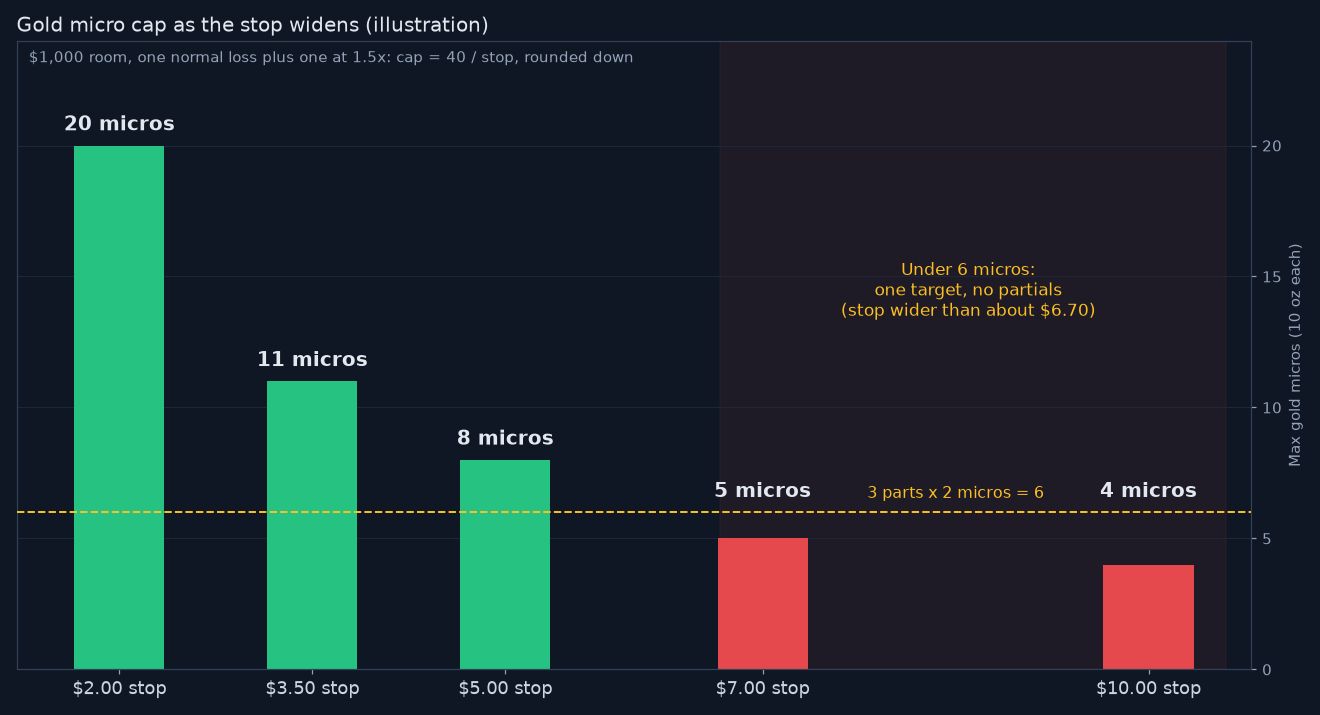
With $1,000 of room and one normal loss plus one at 1.5 times, the cap in micros is simply 40 divided by the stop in dollars, rounded down. That gives 20 micros at $2, 11 at $3.50, 8 at $5, 5 at $7 and 4 at $10.
- img_12628_r2.png (61.31 KiB) Viewed 353 times
The chart above is an illustration of that curve. The part people miss is what happens to trade management as the bar shrinks.
I scale out in three parts and want at least two micros in each, so anything under six micros means one target and no partials. At $7 that is where I end up, and a plan built around taking a third off at 1R simply does not exist.
So once the stop widens past about $6.70, I switch to a single target before the session rather than discover it mid trade. LondonScalper, do you keep partials on small caps, or go all or nothing too?
Re: Apex: lot cap math for gold volatility days
Posted: Thu Oct 29, 2026 10:58 am
by Shadow Trader
Fixed lot sizes ignore the market's current volatility. Ten micro lots with a three-pip stop carry far more risk when the market is calm than when it is wild, because stops get hit at different frequencies.
A volatility-based method sets the stop distance from ATR and then calculates the lot size so that the money at risk is a fixed small percentage of the account. When ATR rises, the stop widens and the size shrinks. When ATR falls, the opposite happens.
This keeps risk per trade consistent in monetary terms while adapting to conditions. It also stops the common mistake of trading the same size in vastly different environments.
The method needs a pip value calculation for each pair, which differs for yen pairs and crosses. A spreadsheet or a calculator tool handles this.
Backtesting the approach against fixed size on past data often shows smoother equity curves, though not necessarily higher profits.
Using a fixed risk percentage also makes performance comparisons across periods meaningful. Without it, a good week with oversized trades looks identical to a good week with normal size, and the risk behind each remains hidden. A journal line for risk in currency terms solves this at almost no cost.
Pairs also differ in their typical ATR, so the same percentage risk results in different lot sizes for each. A pair with a larger typical range gets smaller positions, which naturally balances exposure across the pairs traded. This is one of the simplest ways to prevent one volatile pair from dominating the results.
A final check is to calculate the lot size the system would suggest for the last twenty trades and compare it with what was actually used. The difference shows how far discretion drifted from the rule.
Do you size positions from volatility, or do you use a fixed lot size?