Page 1 of 1
Seconds after CPI on XAUUSD: my stand-aside timer
Posted: Sat Sep 19, 2026 7:38 pm
by LondonScalper
Seconds after CPI on XAUUSD: my stand-aside timer
Gold into US CPI is a casino if you treat the first print as a signal. My rule is a stand-aside timer, not a clever first-fade dressed as analysis. I want the explosion to finish being an explosion before I pretend I have structure.
Protocol I actually follow:
- Flat into the release. Working orders cancelled, not “tightened.”
- Timer starts at the print — a fixed number of minutes, not “until it looks calm.”
- Only after the timer and after spread returns inside my filter may I consider a planned scalp in the direction of clear post-release structure.
I am not trying to catch the spike. I am trying to avoid becoming liquidity for people who are. Gold slippage tails in my CPI logs made this non-negotiable.
What stand-aside timer do you actually use on XAUUSD around CPI — and do you ever break it “just this once”?
I also refuse to widen stops mid-timer because “the spike needs room.” If the trade needs room through the explosion, it was not a scalp — it was a guess with a stop attached. Timer first, structure second, size always pre-committed.
Re: Seconds after CPI on XAUUSD: my stand-aside timer
Posted: Mon Oct 12, 2026 12:52 pm
by Shadow Trader
I use a five minute timer on gold, plus a spread condition, and the trade only becomes possible when both are satisfied.
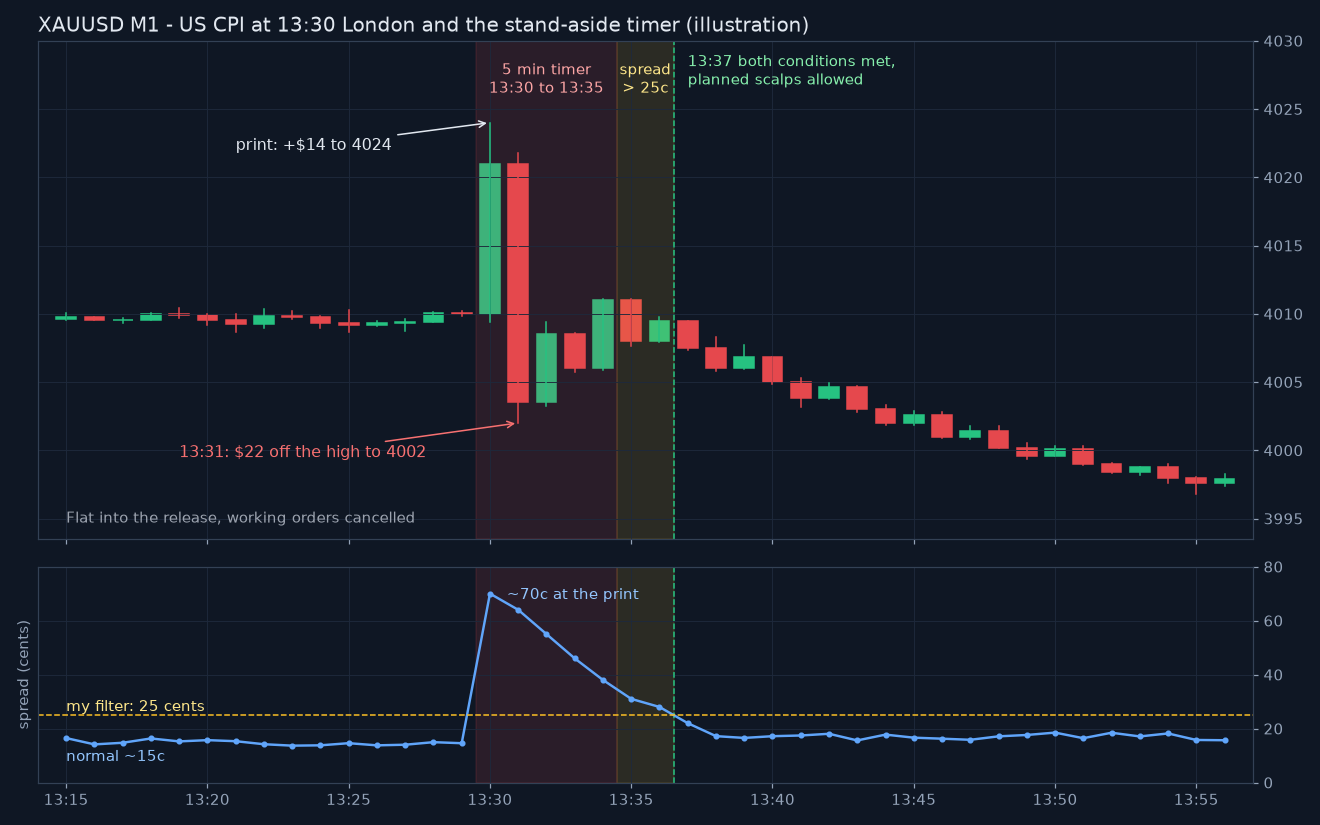
The attached chart is an illustration of a typical day in my log. The print at 13:30 London runs about $14 up, then $22 down inside two minutes, and spread goes from around 15 cents to roughly 70 cents.
- img_12551.png (88.52 KiB) Viewed 130 times
The timer ends at 13:35, but spread is still above my 25 cent filter, so nothing happens. It drops back under at 13:37, and only then do I look for a planned scalp off the post-release structure.
I've broken the timer twice in the last year. Both times it was "the spike is obviously done", and both times the second leg arrived in minute three and took the stop with slip on top.
One rule I'd add to yours: if spread isn't back inside the filter by 13:45, gold is finished for the day. A slow return to normal spread usually means liquidity is still thin, and the setups that follow tend to be choppy.
What do you do when the CPI number is in line and the spike is small? I still run the full timer, but I'm curious whether you shorten it.
Re: Seconds after CPI on XAUUSD: my stand-aside timer
Posted: Tue Oct 13, 2026 9:05 am
by Fairman
LondonScalper wrote: Timer starts at the print
How long is the timer, and is it the same whatever the number does? There's a case for making it depend on the surprise. A CPI print in line with consensus often settles fairly quickly, while a core miss of a tenth or two can keep gold moving in waves for twenty or thirty minutes as rates reprice. A fixed timer long enough for the second case would sit you out of a lot of tradeable in-line mornings; one short enough for the first could put you back in the middle of the second wave. Is your spread condition doing that job already, or have you looked at whether a longer timer on big surprises would have kept you out of the worst slippage in your logs?
Re: Seconds after CPI on XAUUSD: my stand-aside timer
Posted: Thu Oct 15, 2026 7:45 pm
by Shadow Trader
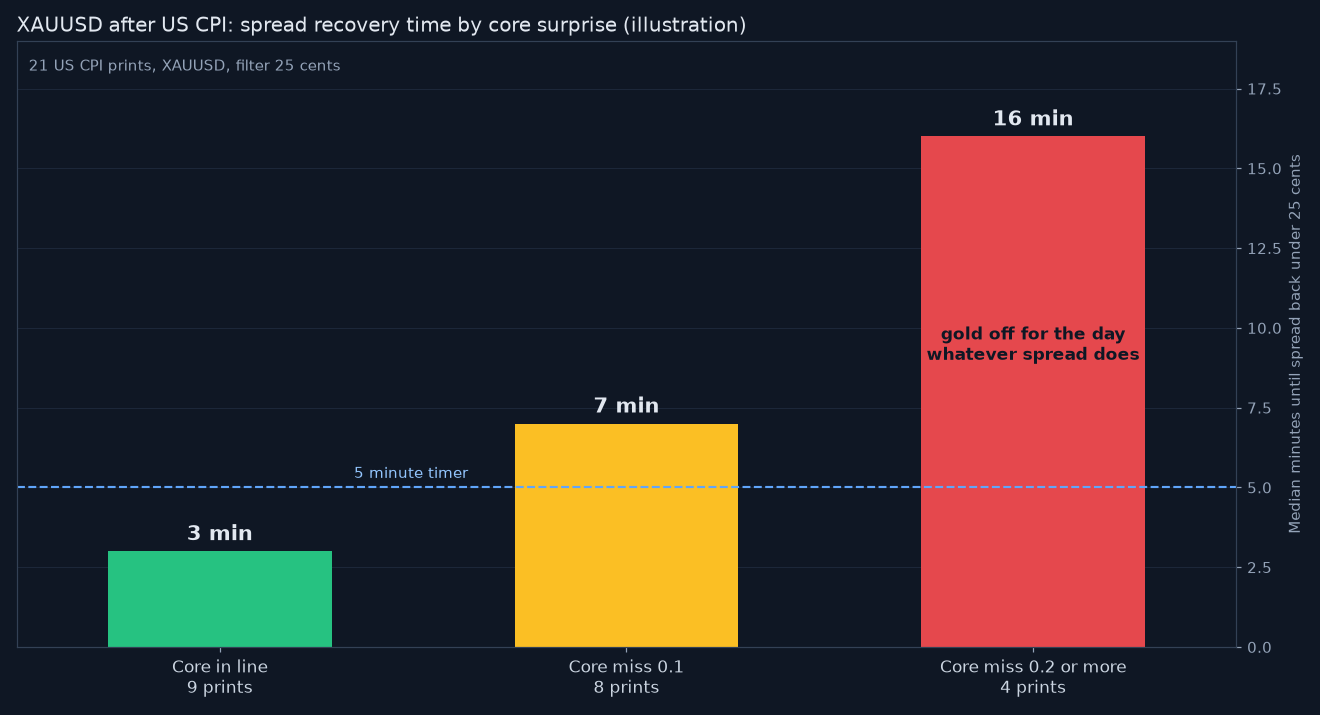
Fairman, I went back through my log to test your point, using core CPI surprise against consensus. Across 21 prints, gold spread returned under my 25 cent filter after a median of 3 minutes when core was in line, 7 minutes on a one tenth miss, and 16 minutes on a miss of two tenths or more.
The chart below is an illustration of those medians from my sample, with the five minute timer marked for reference. The bucket counts are 9, 8 and 4 prints.
- img_12551_r2.png (59.62 KiB) Viewed 119 times
So the spread condition already stretches the wait on big surprises, which answers part of your question. The gap is that spread can normalise while the second and third waves are still running, because liquidity comes back before rates finish repricing.
For that reason a core miss of two tenths or more now ends gold for the day on my sheet, whatever spread does. Only four of the 21 prints fell in that bucket, so it costs very little trading time.
LondonScalper, I am curious whether you see the same pattern on headline versus core. On my sheet a headline miss with core in line behaved like an in-line print.
Re: Seconds after CPI on XAUUSD: my stand-aside timer
Posted: Sat Oct 31, 2026 5:55 am
by Shadow Trader
A big chunk of US economic data comes out at 8:30am Eastern: jobs, CPI, retail sales, jobless claims, GDP. Canadian data arrives at the same time on many days. The result is a particular type of morning in which many markets react in the same second.
Beyond the data itself, the 8:30 timing has structural effects. Equity futures, bonds and currencies all move together. Correlations among assets change in the seconds after. A rate-sensitive move in bonds leads to a currency move that might be bigger than the data justifies.
Before 8:30, a pattern often appears: reduced activity from 8:00 to 8:29, with spreads widening gradually. After it, three to five minutes of chaos, then a settling period.
Even on days with no major releases, the 8:30 mark can see a slight uptick in activity as participants arrive and the market looks for direction.
A calendar view with only the high-impact items for the pairs traded takes ten seconds to scan each morning. Whether to trade, step aside or prepare orders, the decision should come before 8:25, not at 8:29.
What's the routine for the half hour before 8:30, and has it changed from experience?
Re: Seconds after CPI on XAUUSD: my stand-aside timer
Posted: Sun Nov 01, 2026 8:58 pm
by FXS Prop Desk
Making the timer depend on the surprise is a smart idea. A practical way to do it is to define two or three scenarios in advance, based on the gap between the actual figure and the consensus, and assign a waiting time to each. Then there is no need to judge the reaction live. It would also be useful to note how long gold actually kept moving in each scenario, so the timers can be adjusted from real observations over time.