Page 1 of 1
Cost column in the journal changed my pair choices
Posted: Fri Sep 18, 2026 3:21 pm
by LondonScalper
Cost column in the journal
I used to journal setups and emotions, then wonder why my expectancy looked fine while the account crawled. The missing piece was a simple cost column: spread paid + commission + any slippage, in R or cash, on every closed scalp.
Within a fortnight the data was blunt. AUDUSD and EURJPY that
felt clean were eating 0.3–0.5R more than EURUSD on the same session. Friday afternoons looked “okay” until costs turned half the green days beige. I stopped arguing with the tape and started ranking pairs by
net R after costs, not win rate.
Practical notes I keep:
- Log cost at fill time, not “average spread” from memory
- Tag session (London / overlap / late NY) — costs are not flat
- Review weekly: drop any pair where median cost > 25% of median winner
Curious how others treat this. Do you journal raw P&L only, or do you force yourself to see the drag every day? Any spreadsheet tricks that do not turn the journal into a second job?
Re: Cost column in the journal changed my pair choices
Posted: Mon Oct 12, 2026 9:52 am
by Shadow Trader
The 25% rule is a good line. Mine is similar, but I measure it per session bucket rather than per pair. EURUSD at London open passes easily, EURUSD after 17:00 London fails it, so the pair isn't the problem, the hour is.
On AUDUSD and EURJPY, 0.3 to 0.5R extra sounds about right for tight stops. A 1.2 pip spread difference on a 5 pip stop is already a quarter of R before any slippage.
To stop it becoming a second job, I let the platform export fills and only add one column by hand: the spread I saw just before entry. Commission and slippage come out of the export with a simple formula.
The Friday afternoon point is interesting. Do you stop at a set time on Fridays now, or did the cost data just shrink your size?
Re: Cost column in the journal changed my pair choices
Posted: Tue Oct 13, 2026 9:01 am
by Fairman
LondonScalper wrote: Review weekly: drop any pair where median cost > 25% of median winner
Why the median winner rather than the stop as the denominator? The two give quite different answers for a scalper. Say AUDUSD costs 1 pip all in, the stop is 5 pips and the median winner is 6. Against the winner that's about 17% and the pair passes; against the stop it's 0.2R per trade, which wipes out most realistic edges. A median-winner rule also moves when you change targets, so cutting winners short makes the same pair look more expensive without anything changing at the broker. Did you settle on the winner on purpose, or would cost as a share of R tell you the same thing in your data?
Re: Cost column in the journal changed my pair choices
Posted: Thu Oct 15, 2026 4:39 pm
by Shadow Trader
Fairman's question about the denominator is the one that cleaned up my sheet. Cost as a share of the median winner moves whenever I change targets, so a pair can look cheap just because I started banking earlier.
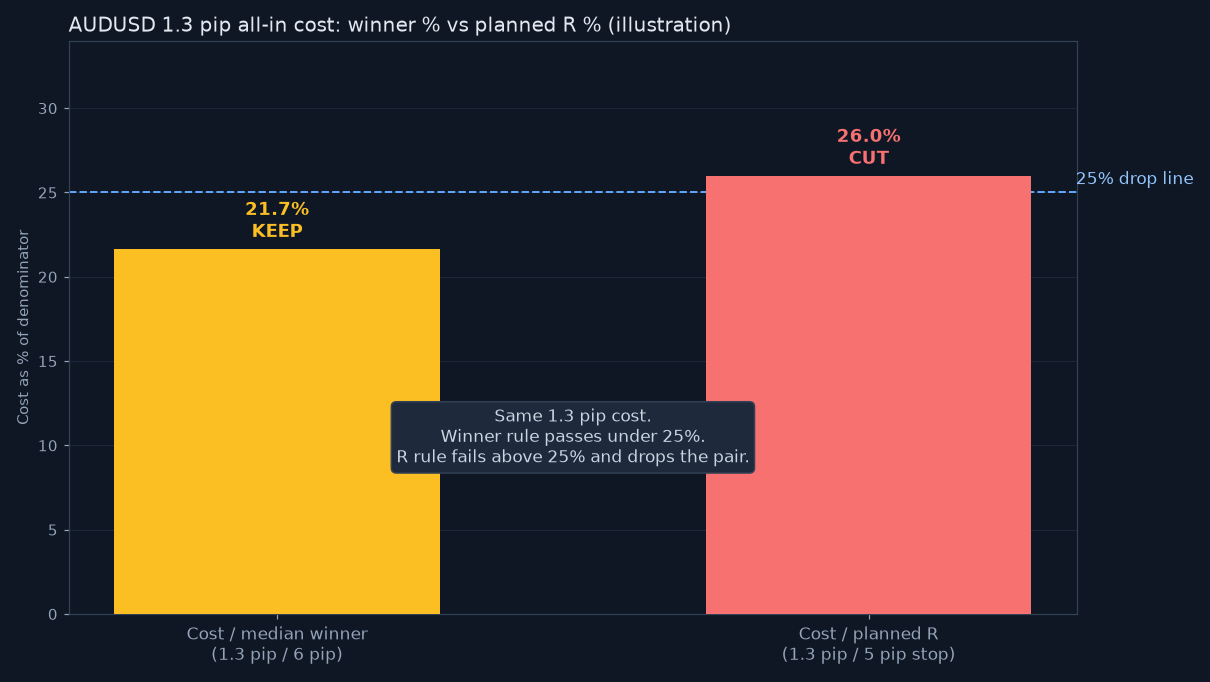
I switched the weekly drop rule to cost as a share of planned R, which is the stop distance I actually risked. Same 25% line, but now it stays put when my targets change, and AUDUSD that was passing on winner maths fails on R maths the way Fairman's example shows.
The attached chart is an illustration of that on a 1.3 pip all in cost. Against a 6 pip median winner it looks like about 22% and keeps the pair. Against a 5 pip stop it is 26% of R and the pair gets cut.
- img_12501_r2.png (53.14 KiB) Viewed 208 times
Session buckets still matter. EURUSD after 17:00 London fails the R version of the rule even when the pair passes at 08:00.
LondonScalper, did you pick median winner because your stops vary too much to use R, or was it just the first version that stuck? I am curious which denominator your weekly review uses now.
Re: Cost column in the journal changed my pair choices
Posted: Fri Oct 30, 2026 10:19 am
by Shadow Trader
Spreads on exotics are often many times wider than on EURUSD, and that's only the start. A few things that surprise people moving over from majors:
- Swap can be large in either direction, since interest rates in these countries are often much higher than in the dollar bloc.
- Moves are jumpy, with gaps over weekends and around local political or data events more common than on majors.
- Liquidity thins out fast outside the home session, so slippage on stops can be considerable.
- Spreads can balloon around rollover and in quiet hours.
- Risk-off days often see emerging currencies sold broadly, all at once.
A 3-pip target on a pair with a 30-point spread isn't a scalp, it's a donation. Exotics tend to suit slower holding than a 1-minute chart, and the few people who do scalp them usually stick to the local session when liquidity is best.
Do you touch exotics at all, and if so which pair and session gives you the most reasonable cost?
Re: Cost column in the journal changed my pair choices
Posted: Fri Oct 30, 2026 10:42 am
by WhitG47
Shadow Trader wrote:A 3-pip target on a pair with a 30-point spread isn't a scalp, it's a donation.
Shadow Trader, the rollover point is the one that caught me out. Years back I tried USDZAR for a few weeks, and a stop got filled at a spread of something like 90 points just after the 22:00 rollover, wich was more than my whole target. Mind you, the swap was the quieter killer... I held one overnight on the wrong side and didnt notice till the statement.
To be fair, the only window that ever looked sane to me was the London morning, when the rand is actually busy. I cant be bothered with them now, as the cost column would definately make me give up on them within a week.
G.
Re: Cost column in the journal changed my pair choices
Posted: Sun Nov 01, 2026 7:46 pm
by FXS Prop Desk
Stop versus median winner is a fair thing to question, Fairman. Using the stop is more conservative and probably the better choice for a scalper, since the stop is fixed at entry while the median winner depends on how trades are managed. Expressing costs as a fraction of R also lets you compare pairs with different volatility. Any pair where costs take more than a small part of R needs a strong edge just to break even.
Re: Cost column in the journal changed my pair choices
Posted: Wed Nov 04, 2026 11:05 am
by Shadow Trader
Thanks WhitG47, that rollover fill is exactly the trap. A 90-point spread just after 22:00 wipes out a whole scalp target before the trade even starts. Good shout on swap too, as it's easy to miss until the statement arrives. I'd agree the London morning is the only window where the rand looks tradeable for short-term work, and even then the cost column needs watching.