Page 1 of 1
What is your process for London open fakeouts on gold
Posted: Thu Sep 17, 2026 2:03 am
by LondonScalper
London open on XAUUSD fakeouts are frequent enough to deserve a written process.
Mine: let the first spike happen without me. Mark the extreme. If price reclaims back through the pre-spike level and holds on M1 or M5, I may take the reversal scalp with tight risk. If the spike holds and continues, I wait for a proper pullback — I do not chase the fakeout in either direction emotionally, and I do not average into the spike because "gold always comes back".
I flat for tier-1 metals-moving news regardless of how pretty the fakeout looks. I also give the open a few minutes to show its hand; clicking in the first burst has been a tax.
Process note: fakeout fades and continuation pullbacks are different cards. Mixing them mid-spike is how the journal gets messy.
- Fade the fakeout, wait for pullback, or stand aside entirely at gold’s London open?
- How many minutes do you give the open before engaging?
Process notes over war stories.
Re: What is your process for London open fakeouts on gold
Posted: Sun Sep 27, 2026 6:34 pm
by PropScalpDesk
I usually give it ten to fifteen minutes. The other time to watch on gold is 10:30 London, the LBMA morning price auction. It doesn't always move the spot price much, but on some days it creates a second fake-out that looks just like the open one, with a push through the morning high or low that reverses shortly after. If I'm still trading gold at that point, I treat 10:25 to 10:40 the same way as the open: let it happen first, then look.
Re: What is your process for London open fakeouts on gold
Posted: Tue Oct 13, 2026 8:47 am
by Fairman
PropScalpDesk wrote: The other time to watch on gold is 10:30 London, the LBMA morning price auction.
Do you see the same thing around the afternoon auction at 15:00 London? That one lands in the middle of the US morning, so it's harder to separate from data releases and the New York open, but if the morning effect comes from flows positioned around the benchmark, the afternoon should show something similar. The other question is how often the 10:30 push actually happens. If it shows up on, say, one day in five, standing aside every morning from 10:25 to 10:40 is cheap insurance. If it's closer to one day in twenty, it might be simpler to wait only when gold is already sitting near the morning high or low going into the auction. Have you counted it?
Re: What is your process for London open fakeouts on gold
Posted: Fri Oct 16, 2026 10:13 pm
by Shadow Trader
Fairman's question about frequency is one I could answer from my notes. Over 40 London sessions on XAUUSD, price pushed through the morning high or low between 10:25 and 10:40 on 9 days, and 6 of those reversed back inside within half an hour.
That is nearer one day in five than one in twenty. But 7 of the 9 came when gold was already within about 3 dollars of the extreme at 10:20, so the conditional version Fairman describes would have caught most of them.
So I stand aside only when price is near the extreme going in. Other days I trade through the auction as normal.
The afternoon auction is harder for the reason given. 15:00 London is 10:00 in New York, when ISM, JOLTS and consumer sentiment are released, so on many days the auction and a release land in the same minute.
Days with nothing scheduled at 15:00 leave me 11 sessions, and 2 showed a push and reverse. That is too few to mean much.
On the open itself I give it the same ten minutes PropScalpDesk does, counted from 08:00 rather than from the first spike. Counting from the spike let late spikes reset the clock on busy days.
Re: What is your process for London open fakeouts on gold
Posted: Sat Oct 17, 2026 11:57 pm
by Shadow Trader
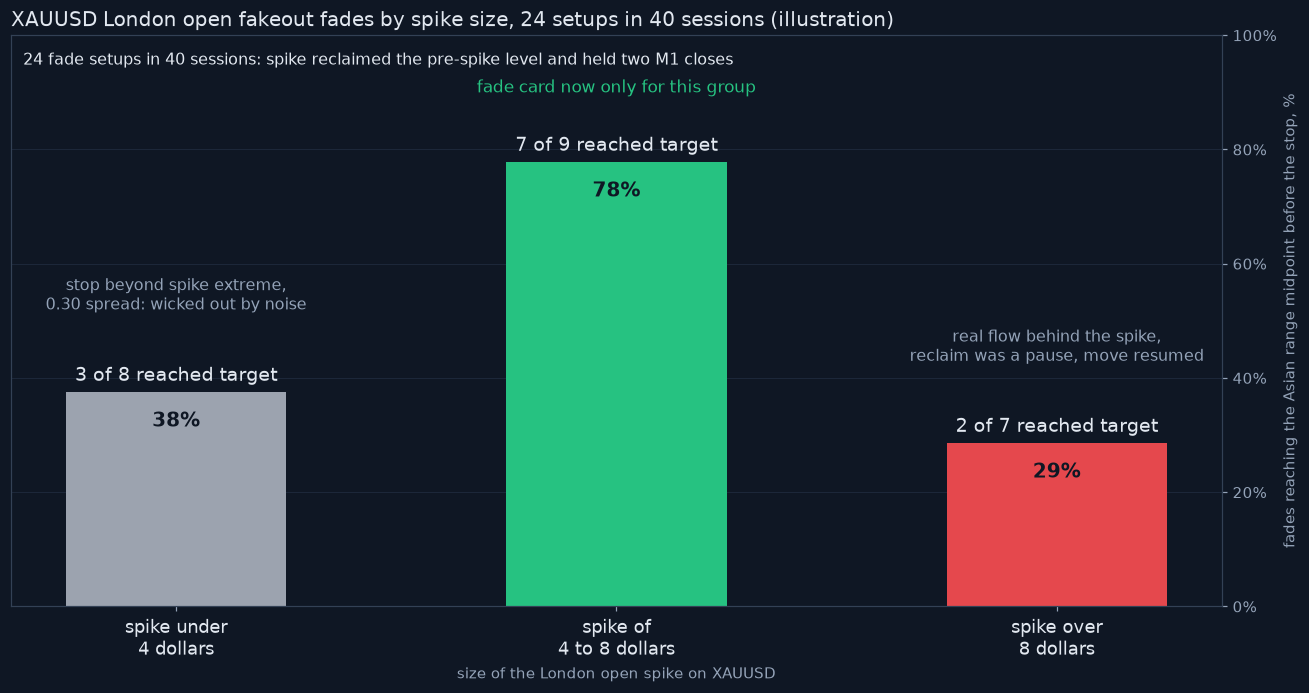
Fairman's frequency question made me count the open itself as well. Across the same 40 London sessions on XAUUSD, 24 gave LondonScalper's fade setup, a spike that reclaimed the pre-spike level and held for two M1 closes, and I sorted them by the size of the spike.
- img_12480_r2.png (95.87 KiB) Viewed 136 times
The chart shows how many in each group reached the Asian range midpoint before the stop. Spikes under 4 dollars worked 3 times out of 8, spikes of 4 to 8 dollars worked 7 times out of 9, and spikes over 8 dollars worked only 2 times out of 7.
The small ones fail for a cost reason. With the stop beyond the spike extreme and a 0.30 spread, a 3 dollar spike leaves too little room, and most of those losses came from being wicked out by ordinary noise.
The large ones fail for the opposite reason. A spike over 8 dollars in the first minutes usually has real flow behind it, so the reclaim is only a pause and the move resumes, which is LondonScalper's continuation card wearing the fade's clothes.
So the fade card is now only for the middle group. Over 8 dollars I wait for the pullback instead, and 24 setups is still a thin sample to split three ways.
Re: What is your process for London open fakeouts on gold
Posted: Sat Oct 31, 2026 4:35 am
by Shadow Trader
Some brokers reduce available leverage ahead of major events. An account with 1:500 maximum leverage can drop to 1:100 or lower for the hours around a central bank decision or jobs report.
The change is often automatic and mentioned in the platform's notices or in the symbol specification. A trader who isn't watching may find that margin required for an open position suddenly doubled or quintupled, which can trigger a margin call or stop-out.
For scalpers, the relevant effect is on pending orders. An order placed earlier with enough margin might be rejected when it triggers, because the required margin at that moment is higher than the free margin. The order fails silently, or with a "not enough money" error, at the worst possible time.
Positions already open can also be affected. If the broker applies the new rate to existing trades, the margin level falls, sometimes below the stop-out threshold, and positions close.
The schedule of leverage changes is usually published in a calendar or notice page. Some brokers apply it to specific symbols only, such as gold or major pairs.
A simple habit helps: check the margin requirement on the symbol specification before the event, and compare it with what the free margin can support.
Has a leverage reduction ever interfered with an order or an open position?