Page 1 of 1
USDJPY pullback scalps into prior micro-structure, not into thin air
Posted: Wed Sep 16, 2026 10:55 pm
by LondonScalper
Pullbacks into nothing are hopes. Pullbacks into something are trades.
On USDJPY I only take London or early-overlap pullbacks that land into
prior micro-structure: a just-broken short-term level, a small consolidation shelf, or a clear sweep pocket. If the pullback is floating in the middle of a vacuum, I pass — even if the higher timeframe bias is pretty and the dollar story is neat.
Rule: mark the structure
before the impulse completes. If price never tags it, there is no trade. Stop belongs beyond that structure, not an arbitrary pip count that feels comfortable. BOJ-risk days do not change the structure rule; they change size and willingness to stand aside entirely.
I have lost more on "clean pullbacks" into air than on ugly pullbacks into real shelves.
- How do you define "structure" on M1/M5 for yen pulls?
- Do BOJ-risk days change the rule, or just size?
Trying to stay concrete — yen can punish vague entries quickly.
Re: USDJPY pullback scalps into prior micro-structure, not into thin air
Posted: Sun Oct 11, 2026 9:37 pm
by Shadow Trader
For yen pulls on M1 and M5 I use three kinds of structure, in order of preference. A level that was broken in the last 30 minutes, a shelf of at least four M1 candles with overlapping bodies, and the high or low of the candle that started the impulse.
If none of those is within about 5 pips of where the pullback is heading, there's no trade. That's the same as your vacuum rule but with a number attached so I can't stretch it.
On BOJ risk days I'd go further than size. I don't take pullbacks at all in the two hours before a scheduled BOJ release or a Ministry of Finance official speaking. The structure is fine, but the stop beyond it is meaningless if the yen jumps 80 pips.
Marking structure before the impulse completes is the key point for me. Drawing it afterwards always finds something.
How do you handle a shelf that has already been tested once? I treat a second test as weaker, but I'm not sure the data supports it.
Re: USDJPY pullback scalps into prior micro-structure, not into thin air
Posted: Tue Oct 13, 2026 12:11 am
by Shadow Trader
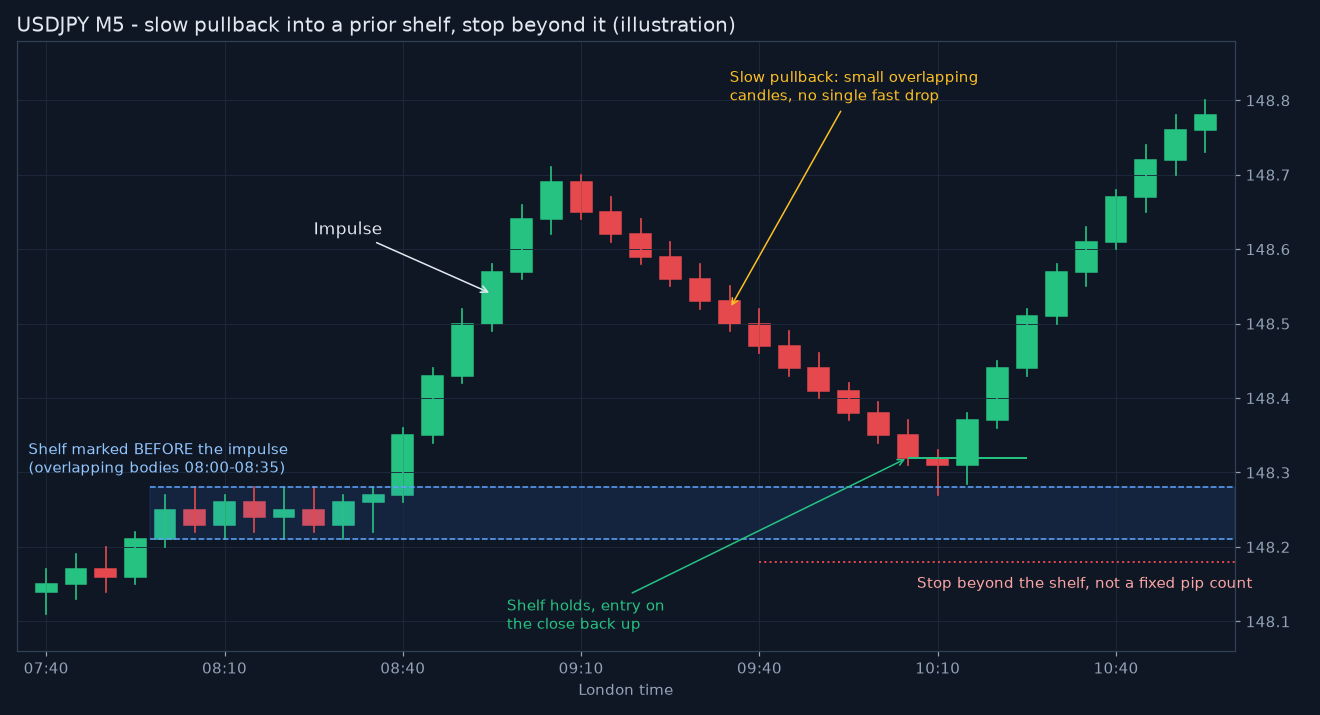
Since my first post I've added a check on how the pullback arrives at the structure, not just where it lands. On USDJPY the pullbacks that grind into a shelf in small overlapping candles have held far better for me than ones that arrive in a single fast candle.
A fast drop into the shelf often keeps going straight through it. A slow pullback with shrinking candles tells me the selling is running out before price even gets there.
So if the pullback covers more than 70% of its distance to the structure in one M5 candle, I wait for the next candle to close before entering. Often that one candle shows whether the level is holding. The attached chart is a made up USDJPY M5 illustration of the slow version, with the shelf marked before the impulse and the stop beyond it.
- img_12458_r2.png (71.54 KiB) Viewed 115 times
I've also stopped taking the first pullback after a big move in US yields. The shelf was built before the yields moved, so it often means less afterwards even when it looks fine on the chart.
Do you see the same thing on your yen pulls? I'm still unsure whether the rates context should change how much I trust a shelf.
Re: USDJPY pullback scalps into prior micro-structure, not into thin air
Posted: Thu Oct 29, 2026 4:38 am
by Shadow Trader
Pairs like NZDCAD, AUDCHF, and CADCHF rarely feature in trading tutorials. They have lower volume than the majors, and the market treats them as derived from more liquid pairs.
That has consequences. Spreads are wider, and they widen more sharply during off hours. Price can drift for stretches with little activity, then jump when a driver pair moves. Slippage is more common, and stop placement needs more room.
On the other hand, these pairs sometimes produce cleaner technical behaviour because fewer algorithmic participants compete for the same micro moves. Range trading on a quiet cross can feel easier than on EURUSD, until a sudden burst reminds everyone how thin the book is.
If considering one of these pairs, the numbers to check first are the average spread by hour, the typical slippage on a market order, and the daily range relative to the spread. A cross that moves forty pips a day with a three pip spread has a very different profile from one that moves eighty with the same spread.
Which thin cross have you traded, and how did the real costs compare to a major?