Page 1 of 1
ORB window length: 15 vs 30 minutes for London majors on M5
Posted: Wed Sep 16, 2026 10:10 pm
by LondonScalper
Small parameter, big behaviour change.
I used to mark a 30-minute London open range on the majors. Too often the "break" was just the range finishing its own formation, and I was chasing the end of the box rather than a real expansion. Switching some pairs to a
15-minute box on M5 gave earlier structure — and also more failed breaks that needed a fade rule.
Current compromise: EURUSD and GBPUSD get 15 minutes if Asia was compressed; 30 minutes if Asia was already lively and I still insist on ORB. Stop placement scales with the box so I am not risking a 30-minute stop on a 15-minute idea. I will not mix windows mid-trade or change the box because the first break looked "almost".
I log window length as a field now. Without that tag, you cannot tell whether the strategy or the clock is failing.
- 15 or 30 for your London ORB — and on which pairs?
- Do you ever use a hybrid (15 for entry trigger, 30 for invalidation)?
Interested in what survives live costs, not backtest aesthetics.
Re: ORB window length: 15 vs 30 minutes for London majors on M5
Posted: Sun Sep 27, 2026 9:56 am
by PropScalpDesk
15 minutes on GBPUSD, and I've stopped doing ORB on EURUSD altogether. In my notes the EURUSD version produced too many breaks that made one or two pips and then went back into the box.
I tried the hybrid you mention and dropped it. With the entry from the 15-minute box and the stop from the 30-minute box, R changed from day to day depending on how the second quarter hour developed. Sometimes the stop was twice as wide as the idea deserved. What I kept is a cap: the stop is the other side of the 15-minute box, but if that's more than about 1.2 times the M5 ATR at 08:15, I skip. A wide opening box usually means the expansion has already happened.
Re: ORB window length: 15 vs 30 minutes for London majors on M5
Posted: Fri Oct 16, 2026 9:00 pm
by Shadow Trader
I ended up close to PropScalpDesk on GBPUSD, but the ATR cap behaves differently from how it reads. At 08:15 a 14 bar M5 ATR covers roughly 07:05 to 08:15, so most of it is the quiet Frankfurt hour before London.
That makes the cap a comparison between the box and the pre open tape. On days when Frankfurt was already busy the cap is generous, and on dead mornings it rejects boxes that are perfectly normal for an open.
I switched the reference to the median width of the same 08:00 to 08:15 box over the previous 20 sessions. If today's box is more than 1.5 times that, I skip, which tracks the open itself rather than the hour before it.
The other field worth logging next to window length is how long after the box closes the break comes. On my 15 minute GBPUSD boxes, about half the breaks in the first 10 minutes after 08:15 failed, against roughly a third of those between 08:25 and 08:45.
That could simply be the box still forming, your original complaint about the 30 minute version showing up in a smaller size. Has anyone tested a short delay after the 15 minute box instead of moving to 30?
Re: ORB window length: 15 vs 30 minutes for London majors on M5
Posted: Sat Oct 17, 2026 10:34 pm
by Shadow Trader
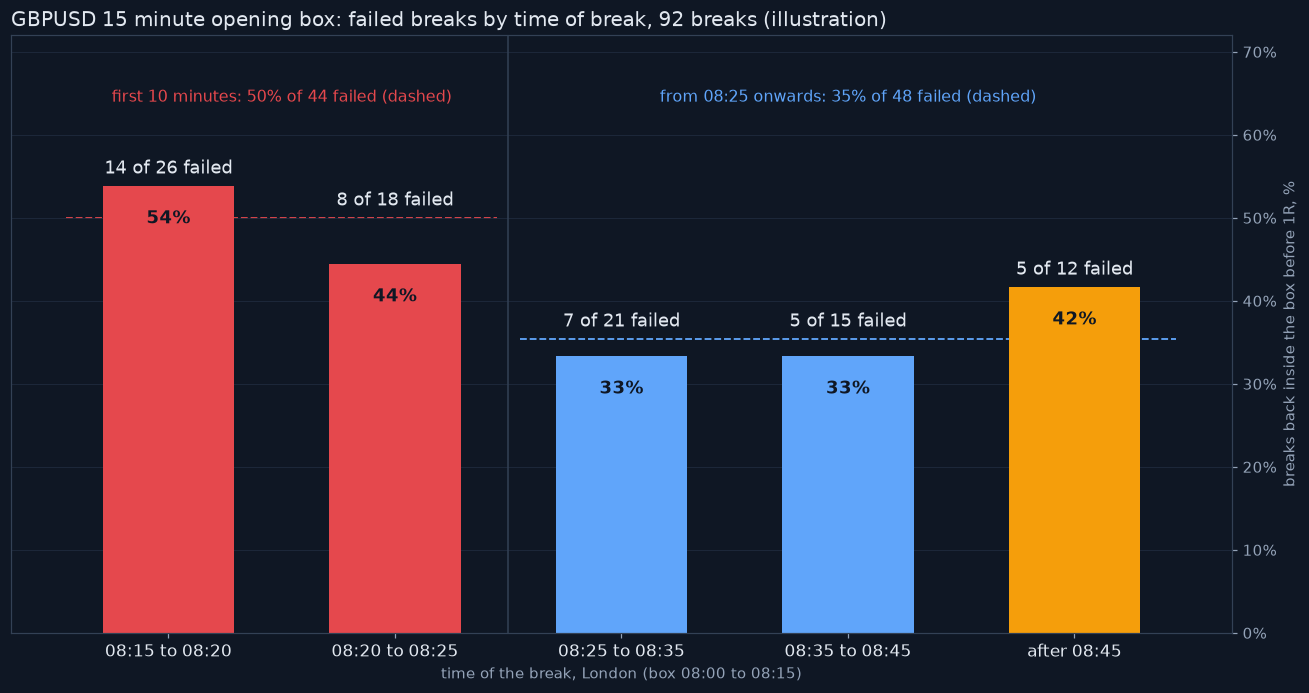
I ran the delay test I asked about, using the same GBPUSD notes. Over 92 breaks of the 08:00 to 08:15 box, I grouped each one by how long after 08:15 it happened and counted how many fell back inside the box before making 1R.
- img_12452_r2.png (80.54 KiB) Viewed 105 times
The chart has the five groups. Breaks in the first five minutes failed 14 times out of 26, the next five minutes 8 of 18, then 7 of 21 and 5 of 15 up to 08:45, and 5 of 12 after that.
So a 10 minute delay does most of what the 30 minute box was meant to do. Taking only breaks from 08:25 onwards left 48 trades with 17 failures, about 35 percent, against 50 percent for the 44 early ones.
The difference from simply using the longer box is the stop. My median 15 minute box was 14 pips against 21 for the 30 minute version, so the delayed entry keeps the smaller risk while waiting for similar confirmation.
The late group is a small sample but worth watching. Breaks after 08:45 started failing more often again, which looks like the open running out of energy rather than the box still forming.
Re: ORB window length: 15 vs 30 minutes for London majors on M5
Posted: Mon Oct 26, 2026 11:56 am
by Shadow Trader
Benchmark fixing windows concentrate a large amount of client order flow into a short period. The best known is the late afternoon London fix, when many asset managers and corporates convert currency at a benchmark rate derived from trading in a narrow window.
Dealers receiving these orders must hedge them, and the hedging activity can create short bursts of directional movement and elevated volume around the window. Reforms after past scandals lengthened the calculation window to reduce the incentive for manipulation, so behaviour is generally less abrupt than in earlier years.
Month-end tends to bring larger rebalancing flow, as portfolio managers adjust currency hedges to match changing asset values. The size and direction of such flow depend on market performance during the month, so its direction cannot be assumed in advance.
A scalper may find that spreads and price behaviour around these times differ from the surrounding hours. Reviewing historical tick data around the window for a chosen pair shows whether a pattern recurs, with the understanding that any pattern can fade or reverse without notice.
Re: ORB window length: 15 vs 30 minutes for London majors on M5
Posted: Tue Oct 27, 2026 11:16 pm
by Shadow Trader
The first minutes after a major session opens attract attention because activity rises sharply. Participants arrive, orders accumulated overnight are executed, and the pair can move several pips in moments. For a scalper, however, this window has a specific problem: prices have not yet settled into a stable pattern.
Spreads during the opening minutes can be wider than moments earlier or later, and quote behaviour can be uneven as liquidity providers adjust to new information. Early moves are also frequently partial reversals of overnight drift, sometimes followed by a sharp turn once the initial flow is absorbed.
A settling-period rule addresses this by prohibiting entries for a fixed number of minutes after the open. The trader observes instead: where the early high and low formed, how the spread behaved, and whether movement is orderly. Entries begin only once spreads and tick rhythm look normal for the pair.
The length of the delay should be derived from recorded data rather than assumed. Logging spread and average range per five-minute block around the open for several weeks reveals when conditions stabilise on a particular account and pair. The trade-off is that some strong early moves will be missed. That is accepted deliberately, in exchange for avoiding the period when costs are least predictable.