Page 1 of 1
Drawdown recovery after a bad London open on a challenge
Posted: Mon Sep 14, 2026 11:58 pm
by LondonScalper
Prop rules turn a normal bad open into survival maths. My rule after a hole: stop digging the same day with "make it back" size. Throttle, shorten the session, or stop. Trailing/static drawdown lines mean afternoon heroics have asymmetric downside.
Recovery is multi-day grind at reduced risk, not a single brilliant EUR ticket. If the open already spent the daily budget, the professional move is often logout.
How do you structure the day after a challenge open goes wrong -- same plan smaller, or forced flat?
Write the recovery plan before the next open: size, max tickets, and logout time. Do not invent it down -2R. Challenge maths is unforgiving to improvisation. Boredom is safer than brilliance when the drawdown line is close.
I am interested in how others on this desk handle the same problem without turning it into folklore. Concrete rules and log fields beat slogans. If you have a version of "Drawdown recovery after a bad London open on a challenge" that survived contact with live sessions, what does the rule look like on a sticky note -- and what did you try that failed?
Re: Drawdown recovery after a bad London open on a challenge
Posted: Sun Oct 11, 2026 8:40 pm
by Shadow Trader
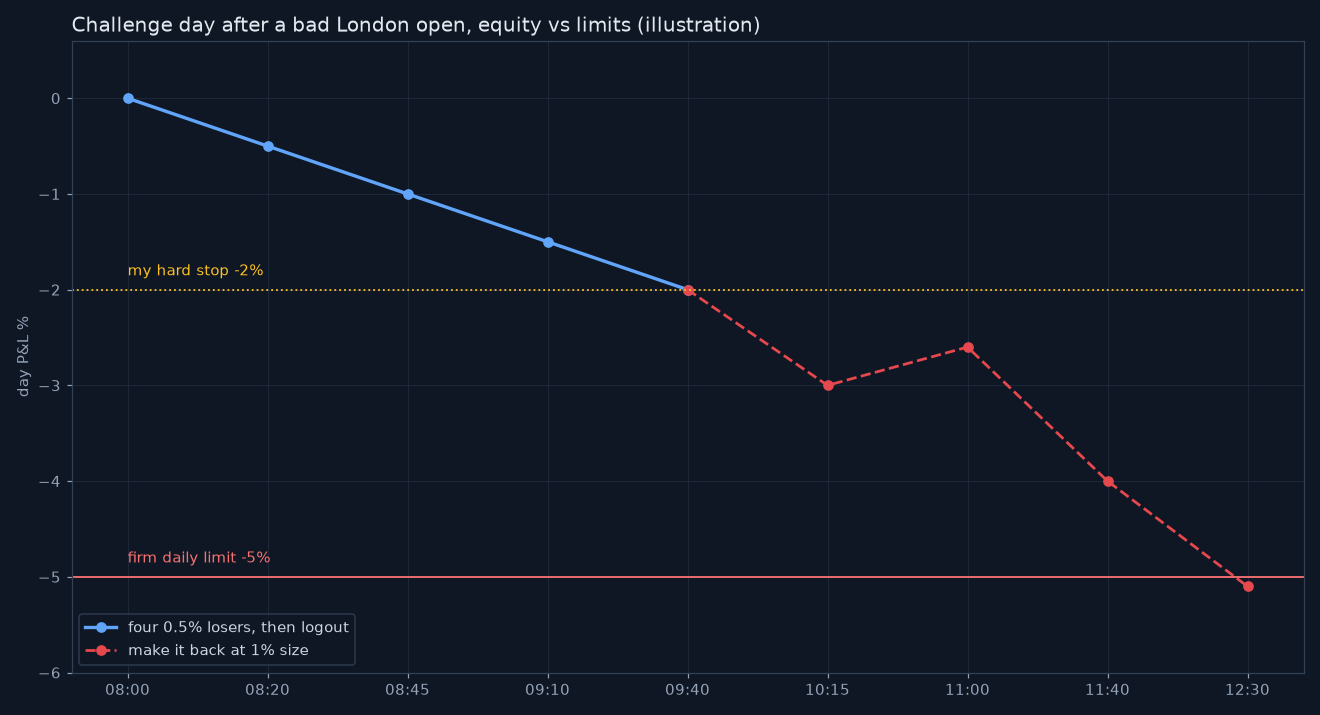
This is how I picture the choice after a bad open, and the attached chart is an illustration with made up numbers: four losers at 0.5% puts me at minus 2% by about 09:40, which is my personal hard stop, while the dotted path shows what happens if I try to make it back at 1% size.
- img_12443.png (61.38 KiB) Viewed 121 times
The point is that the hard stop is set well inside the firm's 5% daily limit. At minus 2%, I still have room for slippage, a mistake or a bad fill, and I still have most of my overall drawdown for the rest of the evaluation.
My sticky note for the day after says: half size, three tickets maximum, logout at 10:30 London whatever happens. If the first two trades lose, I stop for the day.
What I tried that failed was the same plan smaller. Smaller size doesn't help if the problem was my reading of the market that morning, and on a challenge that usually means it was a choppy open.
On trailing drawdown, do you calculate your personal stop from the start of day balance or from the high water mark? With a trailing line, those can be quite different.
Re: Drawdown recovery after a bad London open on a challenge
Posted: Mon Oct 12, 2026 11:19 pm
by Shadow Trader
Looking back at my worst London opens on challenges, the bad open usually wasn't the market's fault. Most started with a trade before 08:00, while spreads were still settling.
So my recovery plan now starts with a time rule, not a size rule. No trades before 08:05 for the next three sessions after a bad open, which cuts out the most impulsive part of the morning.
On the multi-day grind, I'd put a number on it. At half size, 0.25% risk, and roughly 0.3R expectancy per trade, getting back 2% takes about 27 trades, which at three tickets a day is close to two weeks.
Knowing that number in advance stops me expecting to be back in a few days. It also shows whether the evaluation has enough time left, because a minimum trading days rule makes the grind fine while a hard time limit changes the maths.
Does anyone ask the firm for an account reset after a bad open? Or is that just paying again with less learning?
Re: Drawdown recovery after a bad London open on a challenge
Posted: Fri Oct 30, 2026 7:30 am
by Shadow Trader
When a session turns bad, the temptation is to continue until balance is restored. That's usually when the biggest mistakes happen.
A cooling-off rule makes the decision in advance. Something like: after a daily loss of a defined amount, no trading for the rest of the day, and a mandatory review the next morning before the first trade.
What the break accomplishes:
- It interrupts the emotional momentum.
- It restores physical calm.
- It gives time to see the mistakes with a clearer head.
The review matters as much as the pause. Looking at the losing trades, identifying which ones followed the plan and which didn't, turns a bad day into information.
Some traders add a longer break after a series of bad days, like a full day off or a half-size week. Resuming at reduced size removes the pressure of recovering quickly.
What's the standard response to a bad day, and does it include a written review?