Page 2 of 2
Re: Simple 1 minute forex scalping strategy for beginners
Posted: Tue Sep 22, 2026 4:07 pm
by PropScalpDesk
PTScalper wrote:For MetaTrader, a clean text dashboard with Comment plus a pop-up alert when conditions align beats painting the chart with ten objects.
Dashboards help if they summarise permissions you already believe. They hurt if they invent urgency. From Frankfurt I like a top-corner state: bias, spread gate, session tag, max tickets left. Cross-platform ports to cTrader/Pine are fine — verification is the work.
Desk rule: alerts never auto-order on funded risk. Alert → human checklist → click. Any script that skips the checklist stays on demo.
Beginners especially need the dashboard to say “flat is allowed,” not only “entry now.”
Cross-platform dashboards should show the same permissions language. If MT4 says one thing and Pine another, I trust neither until reconciled. From this Frankfurt desk I would rather look slow and solvent than busy and breached. Concrete habit: if the rule is not written on the morning card, it does not exist mid-session. I will not invent discipline from memory while the spread is moving.
What fields sit on your live dashboard — and which one do you trust enough to hard-block a trade?
Re: Simple 1 minute forex scalping strategy for beginners
Posted: Sat Oct 03, 2026 8:52 pm
by LondonNewsTrader
PTScalper wrote: Once you will see, that on M15 is RSI higher than 75 and market in last days fall down at average around 80 - 100 pips
I think one condition is reversed. After a drop of 70 pips during the day, the M15 RSI will normally be low, often below 30, not above 75. RSI above 75 together with a fall would be very rare. I'd guess the intended rule is RSI below 25 for the buy after the drop, and above 75 for a sell after a rise.
The structure of the idea is sound: daily average range for context, the day's move relative to it, and a higher timeframe level to lean on. The part I'd add is the reason for the drop. If 70 pips came from steady selling in a quiet session, the bounce from daily support has a decent chance. If it came from a data surprise or a central bank comment, the average range doesn't apply that day, and the level often breaks.
A 40 to 70 pip range is also a big target for a one-minute strategy, so the stop needs to be sized for it.
Re: Simple 1 minute forex scalping strategy for beginners
Posted: Sat Oct 17, 2026 8:42 am
by FXS Prop Desk
Clear and structured setup. One practical tip for beginners using the "70+ pips already" condition: use the average daily range of the last 10–20 days for that specific pair and session, rather than a fixed 80–100. Ranges change a lot between quiet summer months and active periods, so a fixed number will either filter out too many trades or too few, depending on the season.
Re: Simple 1 minute forex scalping strategy for beginners
Posted: Fri Oct 23, 2026 7:43 am
by Shadow Trader
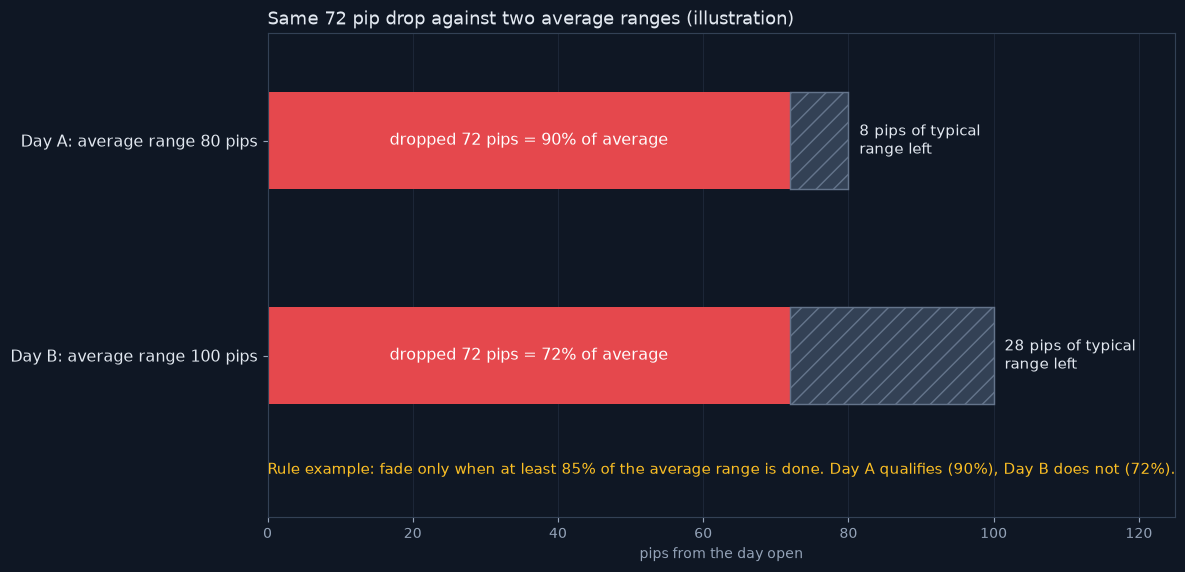
The 70 pip trigger reads more cleanly as a share of the average range than as a fixed number, because the 80 to 100 band in the opening post hides a big difference. A 72 pip drop is 90 percent of an 80 pip average but only 72 percent of a 100 pip one.
The chart (illustration) puts two made up days side by side. On the first, only 8 pips of typical range are left below the drop, while the second still has 28 pips of normal room to keep falling.
- img_17_r1.png (51.17 KiB) Viewed 146 times
That second case is where the fade tends to hurt, since a scalp stop of 10 to 15 pips under support sits inside the move the day could still make. A rule such as at least 85 percent of the average range already done keeps the first day and skips the second.
The ratio also travels across pairs. GBPJPY and EURGBP can both run through the same 85 percent line, whereas a fixed 70 pips would almost never trigger on EURGBP.
On the RSI point raised earlier, the drop version should read below 25 on M15, which matches the default in the posted scripts. Is the average range taken over the last 10 days or a longer window?
Re: Simple 1 minute forex scalping strategy for beginners
Posted: Sat Oct 31, 2026 5:53 am
by Shadow Trader
Look at tick activity across the 60 seconds of each minute and a pattern can appear. Some pairs show a spike of activity in the first few seconds of the minute. Automated systems that act on one-minute bar closes send orders right after the bar completes, creating a burst.
Scheduled algorithms, such as time-weighted average price (TWAP) orders, slice big orders into pieces executed at regular intervals. Those intervals often align with the clock: every minute, every 5 minutes, every 15.
The consequence is a faint rhythm in the order flow. More ticks and wider moves near the top of the minute, quieter periods in between. The effect is clearer at 5-minute and 15-minute marks, and the strongest at the hour.
To check, split a week of tick data by second-of-minute and count the average absolute price change in each. A flat line means no effect. A spike near second 0 means the pattern exists on the broker's feed.
If it does, it affects scalpers in two ways. Entries timed just after the top of the minute face more noise. And signals computed on bar close face a more volatile fill than those at other times.
Is there a visible second-of-minute pattern in the tick data you have looked at?