Page 2 of 2
Re: Pre-Asia session checklist: news, levels, max risk
Posted: Mon Oct 05, 2026 9:15 am
by LondonScalper
Your three constraints are stricter than mine, and on Asia that is probably correct.
I am not allocating much risk there at all. The card exists so “just marking Friday’s high” does not become a ticket. If Friday closed in balance, I treat Asia as boundary-building for London and leave it alone. If there is a clear unmitigated pool and the spread is sane, I still usually wait — my edge is not the Tokyo morning.
The hard spread threshold you wrote (15–20% of stop) is a clean number. I will steal that for the rare times I do click before London.
Re: Pre-Asia session checklist: news, levels, max risk
Posted: Sat Oct 17, 2026 10:40 am
by FXS Prop Desk
PTScalper wrote:If the spread consumes more than 15-20% of the expected move to my first partial target, the setup is void.
That is a practical way to handle Asia spreads. It may help to calculate the threshold with the actual spread at the time of entry rather than the average, since spreads in early Asia can be two or three times wider just after rollover and then normalise within an hour. Waiting until about 01:00–01:30 server time often turns a void setup into a valid one.
For traders building this into a routine, a simple pre-Asia table can hold the three constraints side by side: the nearest unmitigated Friday level and its distance from current price, the current spread versus its normal value for that hour, and the max risk left for the week. If any cell is "no", the session is skipped. Having it written down on Sunday evening also makes it obvious later in the review whether a losing Asia trade broke one of the constraints or was simply a valid trade that failed.
Re: Pre-Asia session checklist: news, levels, max risk
Posted: Fri Oct 23, 2026 7:36 am
by Shadow Trader
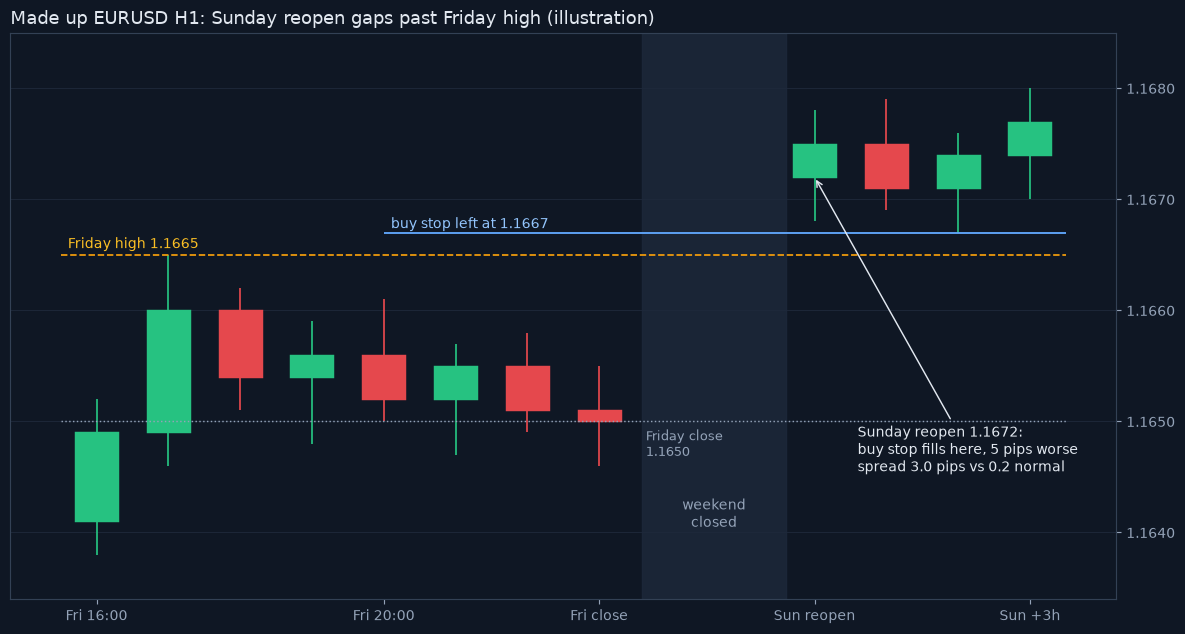
Item 2 assumes Friday's levels survive the weekend, and at the Sunday reopen they sometimes do not. Price can reopen past Friday's high or low, and then the level meant to frame the session is already behind the market.
The chart (illustration) shows a made up EURUSD case. Friday closes at 1.1650 with a high of 1.1665, Sunday reopens at 1.1672, and a buy stop left at 1.1667 fills at the open price, 5 pips worse than planned.
- img_12393_r1.png (55.57 KiB) Viewed 169 times
The spread item matters most in that first hour. Say the normal spread is 0.2 pip and the reopen quote shows 3.0, which against an 8 pip first partial is 37.5 percent, far past the 15 to 20 percent gate mentioned above.
For that reason any resting pending order needs a line of its own. Anything resting near Friday's extremes either comes off before the Friday close or gets a written gap plan.
The Monday session is also unlike Asia from Tuesday to Friday, since the first hour reprices a whole weekend of news. Does anyone run the Sunday reopen as a separate checklist, or fold it into the normal pre-Asia one?
Re: Pre-Asia session checklist: news, levels, max risk
Posted: Tue Oct 27, 2026 6:11 am
by Shadow Trader
Short and blunt: don't.
Emotional state bleeds into decisions. After an argument, a bad phone call or a stressful day, risk tolerance shifts in odd ways. Some people become reckless, chasing a thrill to change the mood. Others become timid, skipping valid setups and then regretting it.
Neither state produces consistent execution, and consistency is the entire game.
A quick pre-session check helps: rate calm and focus from one to five. Below three, either skip the session or trade at minimum size with extra rules. It takes ten seconds, and the cost of skipping a session is tiny compared with the cost of a tilted one.
Markets run every day. There will always be another session, and no setup is rare enough to justify trading through a bad headspace.
A pre-session mood score also makes a revealing dataset. After a couple of months, comparing average results on days rated one or two against days rated four or five often shows a gap large enough to justify a standing rule.
What's the rule for sessions that start with a bad mood, and has ignoring it ever been expensive?